
AI Security Platform Buyer's Guide: How to Choose the Right Solution

Every cybersecurity vendor now claims to be an "AI security platform." Some use AI to automate security tasks. Others secure AI applications. Many do neither particularly well.
If you're a CISO or security leader evaluating platforms, you're drowning in vendor pitches that sound identical. Here's what actually happens: You buy the platform. Six months later, your security teams are still scrambling before audits, vendor questionnaires pile up, and critical vulnerabilities slip through because security teams lack context. Shadow AI spreads unchecked.
I've spent years on both sides of this problem—as an auditor watching companies struggle with platforms that didn't deliver, and as a practitioner building security programs with tools that created more work than they solved.
The stakes are clear: Choose wrong and you get "automation" that creates more manual work, audit scrambles that never end, and security programs trapped in one person's head. Choose right and you get security operations that scale without headcount growth, compliance that flows from good security, and institutional knowledge that survives turnover.
Throughout this guide, I'll use Mycroft's Risk Operations Center as a practical example of what best-in-class looks like—combining AI automation with human expertise to handle security operations at any scale.
What does "AI security platform" actually mean?
Quick Definition Box: An AI security platform is software that combines artificial intelligence, automation, and risk intelligence to help organizations manage cybersecurity, compliance, and third-party risk. The best platforms should also provide continuous monitoring, automated evidence collection, and business context that traditional security tools often lack.
It gets confusing because vendors use the term "AI security platform" in three completely different ways. Understanding which type you need is critical to cutting through sales noise.
- AI-powered security tools: Use machine learning for threat detection and automate repetitive tasks. In reality, most is basic automation with "AI" slapped on. True AI adds contextual intelligence and learns from your environment.
- AI application security: Protect AI/ML models, training data, and generative AI services from AI-specific attacks like prompt injection, data leakage, model poisoning, and insecure agentic AI workflows. In reality, they’re often limited to scanning without remediation workflows.
- Unified security operations platforms: Combine GRC, vulnerability management, TPRM, and cloud security with AI-powered intelligence. In reality, while most platforms promise this, few actually deliver.
The 3 types of AI security platforms
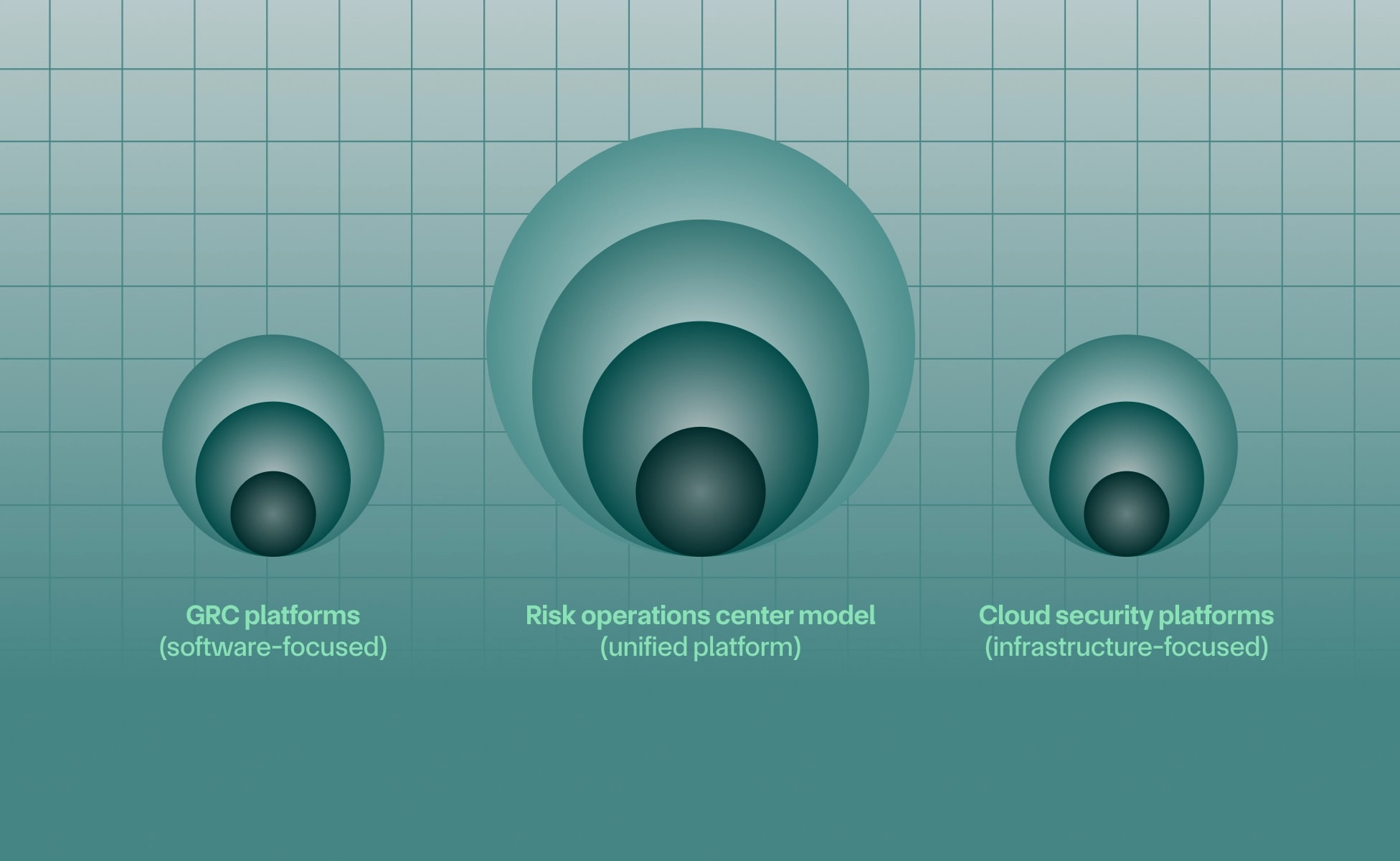
The market breaks down into three distinct approaches, each designed for different use cases and stages of security maturity.
GRC platforms (software-focused)
-
What: Tools focused on compliance automation and evidence collection.
-
Strengths:
- Quick deployment
- Lower cost ($15K-30K annually)
- Good integrations
-
Limitations:
- Software-only (you do implementation)
- Cookie-cutter controls
- Requires 1-2 FTEs to manage
-
Best for: Early-stage companies (pre-Series A) with simple needs and internal resources
Cloud security platforms (infrastructure-focused)
-
What: Platforms focused on cloud infrastructure security and vulnerability management.
-
Strengths:
- Deep cloud integration
- Strong vulnerability detection
- Developer-friendly
-
Limitations:
- Limited GRC features
- Doesn't help with audits
- Requires separate TPRM tools
-
Best for: Cloud-native companies with security engineering resources
Risk operations center model (unified platform)
-
What: Unified platforms combining software, services, and expert teams managing entire security programs.
-
Strengths:
- End-to-end coverage (GRC + vulnerability + TPRM + cloud security)
- AI + human hybrid, ROC teams interface with auditors
- Eliminates "key person" dependency
- Scales from early-stage through enterprise
-
Limitations:
- Higher investment ($100K-150K annually)
- Requires trusting platform team as an extension of your organization
-
Best for: Companies at any stage who want to build security right and avoid migration pain
Keep in mind that, regardless of the platform you choose, it’s only as good as what surrounds it. Software alone won't solve your problems. You need implementation support, ongoing expertise, and a team that understands your business context.
What effective AI security platforms have in common
Regardless of category, effective AI security platforms share a few core traits:
- Unified risk visibility: Security, compliance, cloud infrastructure, and AI applications roll up into a single platform, giving teams real-time insight into how risks connect across systems and data.
- Continuous compliance and control testing: Evidence collection and control validation happen automatically, reducing audit scrambles and lowering the risk of data leaks or missed vulnerabilities.
- Scalable operations powered by AI agents: AI agents automate repetitive compliance and risk workflows, while security teams focus on governance, exceptions, and strategic response, improving security posture without proportional headcount growth.
Caution: Beware the migration tax
Most companies pay a hidden tax: the migration tax. They start with a basic GRC platform, outgrow it in 18-24 months, then spend 6+ months migrating to something more comprehensive. Each migration disrupts operations, loses institutional knowledge, creates security gaps, and costs far more than license fees suggest.
ROC platforms, like Mycroft, eliminate this tax by providing comprehensive coverage from day one that scales with you. The total lifetime cost is lower because you build once and scale continuously rather than rebuilding every two years.
The 8 criteria that truly matter
Once you know which type of platform you need, the hard part begins: separating real capabilities from marketing claims. Use these eight criteria to evaluate any vendor objectively.
Software + services
Every security program is unique. Your compliance requirements, cloud infrastructure, development workflows, and risk tolerances differ from every other company. Out-of-the-box solutions might look great in demos, but they don't truly reflect your actual operations.
The most effective platforms provide three critical elements:
- Implementation engineers who spend time understanding your workflows before building automations
- Ongoing expertise that helps your program evolve as you add frameworks or shift infrastructure
- Audit interface where the platform team talks to auditors on your behalf.
Leading platforms operate like a Security Operations Center for risk management—you get dedicated teams managing operations, forward-deployed engineers building custom workflows, and human analysts providing oversight while AI handles repetition. Most importantly, institutional knowledge stays with the platform, not in one person's head.
Watch for red flags like "set it and forget it" promises, no implementation services mentioned, or you being fully responsible for audit prep despite having an “audit-ready” platform.
Why win with Mycroft:
✅ Implementation and ongoing support included, scaled to your maturity level
Continuous operations over point-in-time compliance
Annual audits are snapshots of your security posture at a specific moment. But your actual risk changes constantly; new vulnerabilities emerge, configurations drift, employees join and leave, and vendors get breached. Platforms that only help with audit preparation leave you exposed for the other 11 months of the year.
Best-in-class platforms offer:
- Maintenance of year-round audit readiness through continuous evidence collection (not quarterly screenshot hunts)
- Real-time control testing that validates controls actually work
- Drift detection when configurations deviate from standards
- Continuous monitoring of vendors and vulnerabilities
This is especially critical for AI applications, where misconfigurations, data leaks, or prompt-based attacks can expose sensitive data in real time—long before an annual audit would catch it.
And when it's time for an annual audit, evidence is already collected, controls are validated, and nothing needs to be scrambled together. The audit becomes a review of continuous operations rather than a special event requiring weeks of preparation.
Be wary of vendors promising "Get SOC 2 in 2 weeks"—that's audit prep theater, not security. Also watch for platforms that focus only on annual cycles or still require manual evidence collection quarterly.
Why win with Mycroft:
✅ Year-round audit readiness, not annual scrambles.
Context and intelligence
Modern security tools generate thousands of alerts daily, but without business context, your security teams drown in noise. Everything seems equally urgent (or equally ignorable.) Critical risks get lost in the flood.
The problem isn't volume alone; it's also a lack of intelligence. A vulnerability scanner might flag 1,000 CVEs, but it can't tell you which ones actually matter to your business. The platform should provide risk prioritization based on business impact (not just CVSS scores), contextual analysis understanding what systems do and who owns them, and attack path analysis showing how vulnerabilities chain together.
At Mycroft, we call this a Risk Information and Event Management (RIEM) platform. Think of this as a SIEM for risk management. It aggregates data from GRC tools, vulnerability scanners, cloud security, and TPRM to provide unified risk visibility and route issues to the right people automatically. With intelligence, 1,000 CVEs become 50 prioritized risks with clear ownership, business context, and remediation guidance.
Why win with Mycroft:
✅ RIEM approach centralizes risk intelligence across all security domains, contextualizing threats in your business context.
True AI (over basic automation)
"AI-powered" has become cybersecurity's favorite marketing buzzword, but there's a massive difference between basic automation and true intelligence. Basic automation follows predetermined rules: if X happens, do Y. True AI adds contextual understanding, learns patterns from your environment, and adapts to your operations over time. The most effective platforms combine AI with human expertise in a hybrid model.
Look for:
- Natural language processing that understands policies and vendor responses,
- Computer vision that validates evidence rather than just collecting it
- Adaptive automation where workflows adjust based on results
- AI agents that autonomously communicate with vendors and pre-fill questionnaires
This is particularly important for genAI security, where risks like prompt injection, unauthorized access to AI apps, and uncontrolled agent behavior can’t be addressed with static rules.
AI handles repetitive tasks at scale while humans handle exceptions, strategy, and complex decisions. The AI learns from human decisions to improve continuously.
Why win with Mycroft:
✅ AI agents automate tasks while human experts provide the judgment and oversight you need.
Integration depth
Platform vendors love advertising integration counts ("350+ integrations!"), but integration quantity doesn't equal quality. Most vendor "integrations" are shallow API connections that require extensive manual configuration and break whenever APIs change. Your security team shouldn't be copying data between systems or manually creating tickets for vulnerabilities.
Deep integrations provide real value through native integrations maintained by the vendor, bi-directional sync where data flows both ways automatically, automated workflows where integrations trigger actions across systems, and context preservation that maintains business intelligence as data moves between tools.
Key categories include:
- Cloud infrastructure (AWS, Azure, GCP)
- Identity systems (Okta, Azure AD)
- Development tools (GitHub, Jira)
- Existing GRC tools you can layer on top of
- Security tools (CNAPP, scanners, EDR)
If it starts feeling overwhelming, just ask yourself this question: Can the platform work with your existing investments and enhance them, or does it require replacing everything? The best platforms offer both native capabilities and integration with tools you already own.
Why win with Mycroft:
✅ All the most critical integrations plus the ability to layer on existing GRC tools
Scalability and customization
Your security program will inevitably evolve. You'll add compliance frameworks as you pursue enterprise customers, expand to new regions with different regulations, launch new products with different security requirements, and acquire companies that need integration. Cookie-cutter platforms work fine at a small scale, then break as you grow.
Many platforms offer "SOC 2 in a box" with prebuilt controls that may technically satisfy auditors but don't align with your actual operations. This creates a situation where you’re compliant on paper without reflecting operational reality. Instead, platforms using a GRC engineering approach build custom control frameworks from scratch, create bespoke automations specific to your technology stack, provide implementation support, and iterate as your program matures.
Look for:
- Custom control frameworks tailored to your environment
- Workflow customization, you can manage without engineering support for every change
- Full API access for custom integrations when needed
- Pricing that scales reasonably with growth, rather than penalizing you for monitoring everything
Why win with Mycroft:
✅ Custom implementations to your actual workflows, whether you're building from scratch or optimizing existing programs.
Speed to value, not speed to compliance
"Get SOC 2 in a week" is a red flag, not a feature. It signals a vendor who doesn't understand that real security takes proper implementation. The cybersecurity industry has created a race to the bottom on speed claims, with vendors competing on how quickly they can get you certified rather than how well they can secure your environment.
Real security requires time to understand your environment and risks, customization to your specific operations, integration with existing tools and workflows, testing to ensure controls actually work, and validation that automations behave correctly. Type 1 audits take 1-2 months minimum (mostly auditor availability). Type 2 audits require 3-6 month observation periods demonstrating sustained control operation (this timeline is not negotiable).
Look for:
- Realistic timelines that don't oversell
- Phased approaches with quick wins first
- Clear paths to reduced workload over time
- Long-term value that compounds
The best platforms get more valuable the longer you use them. AI learns your environment, automations get refined, integrations deepen, and each audit cycle gets easier.
Why win with Mycroft:
✅ Realistic timelines: Type 2 in 3-6 months. 50-70% workload reduction by Quarter 4. No overpromising.
Total cost of ownership
License fees are the smallest part of your real cost. The cheapest platform often costs far more when you account for implementation, maintenance, and hidden headcount costs. Most buyers optimize for sticker price without calculating total cost of ownership.
Calculate all-in costs across direct costs (software license fees, implementation services, integrations development, training) and indirect costs (engineering time on maintenance, security team time managing the platform, opportunity cost of high-value work they're not doing, audit consultant fees if the platform doesn't handle audit prep).
Here's what this looks like in practice:
| Platform A: "Affordable" Software-Only | Platform B: Comprehensive ROC Model |
|---|---|
| $40K/year software + $15K DIY implementation | $100K/year all-in (software + services) |
| 2 FTEs managing internally | 0.5 FTE internally (oversight only) |
| Still hiring audit consultant ($30K) | ROC team handles audit interface |
| True cost: $225K/year | True cost: $150K/year |
The "affordable" platform costs $75K more per year, plus creates opportunity cost in reduced product velocity. Over 5 years, the difference compounds to $375K+ in savings, plus you avoid migration tax when you inevitably outgrow the cheaper platform.
Why win with Mycroft:
✅ Full-stack coverage – GRC, TPRM, vulnerability management, cloud security, AI security unified in one platform.
Questions to ask when evaluating an AI security platform
Vendor demos tend to blur together. Use the questions below to objectively evaluate AI security platforms and compare vendors on what matters most.
Continuous security and compliance operations
- How often are controls tested between audits? Can you show real examples?
- If a critical vulnerability is discovered today, what happens in the first hour, first day, and first week?
- What does audit readiness look like 30 days before an audit versus six months before?
These questions help distinguish platforms built for continuous operations from those optimized only for point-in-time audits.
Context and AI-driven risk intelligence
- How does the platform learn our business context?
- Can we adjust risk scoring to reflect our priorities, data sensitivity, and AI usage?
- How does the platform handle vulnerabilities with compensating controls—does it understand risk mitigation or simply flag issues?
Strong platforms reduce noise by prioritizing risk based on business impact, not generic severity scores.
True AI versus basic automation
- Show me AI working live—what tasks are automated today?
- What manual work still remains after automation?
- How does your AI adapt to our environment, and how long until it’s meaningfully customized?
Look for AI agents that reduce workload over time, not static rules wrapped in “AI” branding.
Integration depth and ecosystem fit
- How does the platform integrate with our existing tools (cloud, identity, development, security)?
- Can we layer this on top of our current GRC tooling, or does it require replacement?
- When APIs change, who maintains integrations—us or you?
Integration quality matters far more than integration count.
Implementation, services, and ongoing support
- What does the first 90 days look like for our team versus yours?
- Who do we work with day-to-day after go-live?
- How do you support us as we add frameworks, expand regions, or adopt enterprise AI?
Platforms that pair software with expert teams consistently outperform software-only approaches.
Scalability, customization, and long-term fit
- Can you show examples of custom control frameworks built for similar organizations?
- How much can we customize workflows without engineering support?
- Do you provide full API access for extensibility?
Security programs evolve, so your platform should evolve with them.
Total cost of ownership and speed to value
- What is the all-in cost for our size, including implementation and ongoing support?
- How much internal effort will this require weekly after rollout?
- What’s the realistic timeline to audit readiness for our complexity?
Beware of vendors optimizing for speed to certification instead of sustainable security.
Deal-breaker questions (ask every vendor)
- What are the main reasons prospects choose not to work with you?
- What’s one thing your platform doesn’t do well today?
- If we’re not a good fit, would you tell us?
Honest answers here are often the most revealing.
Want a structured way to score vendors side-by-side?
Download the full AI Security Platform Vendor Evaluation Scorecard to rate vendors objectively across security capabilities, services, scalability, and total cost of ownership.
Build once, scale continuously: Why we built the Mycroft ROC model
Platforms should grow with you, not require replacement at each stage. I've watched too many companies go through painful migrations every 18-24 months. Each time, they lose momentum, security operations stall, audit timelines slip, and enterprise deals slow down.
This is why we built Mycroft differently. After years as an auditor and then building security programs myself, the problem was obvious: Every existing approach had fatal flaws. DIY GRC platforms give you software but no support.
Regardless of which platform you choose, optimize for total lifetime cost and actual security outcomes, not the lowest license fee. Factor in migration costs, opportunity costs, and security incidents that could be prevented by getting it right the first time.
Remember, the platform you choose today will either enable or constrain your growth for years to come.
FAQs
What is an AI security platform?
An AI security platform combines artificial intelligence, automation, and risk intelligence to manage cybersecurity, compliance, and third-party risk. The best platforms provide continuous monitoring, automated evidence collection, and business context—going beyond simple rule-based automation to provide true intelligence. As organizations adopt enterprise AI, compliance management must extend beyond infrastructure to include AI usage, data flows, and model access controls.
What is a Risk Operations Center (ROC)?
A Risk Operations Center is like a SOC for risk management instead of threat response. It combines AI-powered automation with human security experts to manage your entire security program—GRC, compliance, vulnerability management, TPRM, cloud security—as unified operations. The ROC team handles day-to-day security operations while you retain strategic decision-making authority.
What's the migration tax and how do I avoid it?
The migration tax is the hidden cost of outgrowing platforms every 18-24 months. Each migration costs you 6+ months of disrupted operations, lost institutional knowledge, implementation consulting fees ($50K-100K+), your team's time, and security gaps during transition. Avoid it by starting with comprehensive coverage that scales with you through every growth stage.
How do AI security platforms manage AI-specific risks?
AI security platforms help organizations manage AI risk by securing generative AI applications, autonomous agents, and enterprise AI systems in real time. They provide visibility into shadow AI usage, protect sensitive data from data leakage and prompt injection attacks, and enforce governance and access controls across AI apps and cloud infrastructure.
By combining continuous monitoring, automated response, and centralized control, an AI security platform enables security teams to secure AI without slowing innovation—supporting safe enterprise AI adoption while maintaining a strong security posture.