
ISO 27001 vs SOC 2: Which security framework should your startup choose?

For resource-strapped startups, achieving data security and compliance can be tough. They're often faced with difficult choices, such as: should I pursue ISO 27001 certification or SOC 2 attestation?
It’s important to avoid rushed decisions, as this choice can significantly impact your ability to land enterprise deals and expand into international markets.
In this post, we’ll directly compare ISO 27001 and SOC 2, showing you the key differences and implications for your startup. We’ll also share our take on which framework is better for most US-based SaaS companies, along with the rare cases where ISO 27001 may make more sense.
ISO 27001 vs SOC 2 fundamentals
Let's dive in:
What is SOC 2? SOC 2 is a security and compliance framework developed by the American Institute of CPAs (AICPA). It is focused on evaluating how well a service organization controls and secures its customers' data. There are two types of SOC 2 reports - Type I and Type II. A SOC 2 Type I report examines a company's systems and controls at a specific point in time, while a SOC 2 Type II report assesses the operational effectiveness of those controls over a minimum 6-month period. Both types show how well companies manage data using the five trust services criteria - security, availability, processing integrity, confidentiality, and privacy. SOC 2 compliance is widely adopted by technology and SaaS companies based in North America to build trust with enterprise customers.
What is ISO 27001? ISO 27001 is an information security management standard published by the International Organization for Standardization (ISO). It outlines requirements for building and maintaining an information security management system (ISMS) within an organization. ISO 27001 certification demonstrates that a company has defined and implemented a rigorous set of controls to protect information assets. This framework is commonly used by organizations globally, particularly in regions outside of North America.
The key difference is that SOC 2 is more focused on operational controls and managing service delivery, while ISO 27001 takes a broader, governance-oriented approach to information security management. Both serve to build trust with customers, but have distinct geographic prevalence and implementation considerations.
Do US startups need both? A geographic and market reality check
In the US market, SOC 2 has become the de facto security standard for enterprise-grade SaaS companies. Customers, especially large corporations and government entities, have grown to expect and demand SOC 2 compliance from their vendors. This is because SOC 2 is tailor-made for the needs of the North American market, focusing on the specific security, privacy, and operational controls that US-based businesses require. As a result, startups that can demonstrate SOC 2 compliance often have a significant advantage over competitors when pursuing lucrative enterprise deals.
In contrast, the ISO 27001 framework tends to hold more weight in international markets, particularly in Europe, Asia, and other regions outside of North America. Many organizations outside the US view ISO 27001 certification as a more globally recognized standard for information security management. This can benefit startups looking to expand into new overseas markets, as ISO 27001 may be a required or preferred credential for certain customers and partners.
Reality check: Most US startups don't need both
Most US-based SaaS startups can meet the security requirements by pursuing SOC 2 compliance alone, specifically SOC 2 Type II, given the dominance of SOC 2 in the US enterprise space.
Attempting to achieve both SOC 2 attestation and ISO 27001 certification can often be an unnecessary burden, especially for resource-constrained startups. Unless the startup has firm plans for substantial international expansion in the near-term, the time, effort, and costs associated with dual certification are not justified. For most US startups, focusing solely on SOC 2 is the more practical and cost-effective choice.
ISO 27001 vs SOC 2: Cost, timeline, and operational considerations
When startups are deciding between pursuing ISO 27001 certification or SOC 2 attestation, the most critical factor to consider is the resource allocation argument. Let's take a closer look at the key elements:
ISO 27001 vs SOC 2: Cost comparison
ISO 27001 certification can be more expensive than SOC 2. The upfront costs for implementing the ISO 27001 Information Security Management System (ISMS) can be significant, often requiring dedicated security personnel and consultants. Ongoing maintenance and annual audits also contribute to the higher price tag.
SOC 2 compliance still requires investments in security controls and processes, and tends to be more affordable for startups. The auditing fees for a SOC 2 report are generally lower than the ISO 27001 certification process.
ISO 27001 vs SOC 2: Timeline comparison
Achieving ISO 27001 certification is a lengthier process that can take 6-12 months or more, depending on the maturity of the organization's existing security practices. Startups need to dedicate substantial time and resources to implementing the full ISMS, documenting controls, and preparing for the certification audit.
On the other hand, SOC 2 has a relatively faster timeline. Depending on the startup's security posture, the entire process from initial preparation to completing a SOC 2 Type II audit typically takes 3-6 months. This makes SOC 2 a more viable option for resource-constrained startups that need to demonstrate security compliance quickly.
ISO 27001 vs SOC 2: Operational comparison
Maintaining ISO 27001 certification requires ongoing efforts to review, update, and continuously improve the ISMS. This includes regular risk assessments, management reviews, and internal audits—tasks that can be time-consuming and require dedicated security personnel.
The operational burden for SOC 2 is generally lower. While startups still need to maintain their security controls and processes, the compliance requirements are more streamlined and focused on the specific trust services criteria (security, availability, processing integrity, confidentiality, and privacy), adding a bit of flexibility and extensibility in the process.
When ISO 27001 makes more sense for startups
While SOC 2 is generally the better fit for most US-based SaaS startups, there are a few specific scenarios where pursuing ISO 27001 certification may be the more strategic choice:
- True international expansion: If a startup has firm plans for substantial international growth, especially in regions outside of North America like Europe and Asia, then ISO 27001 can be a more globally recognized credential.
- Specific industry requirements: Certain highly-regulated industries, such as healthcare or finance, may have specific compliance mandates that align better with the comprehensive control framework of ISO 27001. In these cases, the startup may need to pursue ISO 27001 to meet the unique security requirements of their target customers or market.
- Non Product Companies: If you’re a non-SaaS and not delivering a software service, typically ISO 27001 is much better aligned as it’s designed to build an Information Security Management System (ISMS).
- Enterprise customers who explicitly require it: Some large enterprise customers, particularly those with a global presence or in specific regulated sectors, may explicitly require ISO 27001 certification from their vendors. If a startup's target customers have this strict requirement, then pursuing ISO 27001 may be necessary to unlock those lucrative deals.
Why SOC 2 Type II usually wins for US startups
SOC 2 Type II is the optimal choice for US-based startups and scale-ups due to:
- Customer expectations
- Faster time-to-compliance
- Business model alignment
- Compliance ecosystem integration
SOC 2 meets enterprise customer expectations
In the US and wider North American market, enterprise customers have come to expect SOC 2 compliance as a baseline security requirement for SaaS vendors. Demonstrating SOC 2 Type II compliance signals to these customers that a startup has the necessary controls and processes in place to securely manage their sensitive data. Meeting this widespread market expectation can be a major competitive advantage when pursuing lucrative enterprise deals.
SOC 2 is the faster path to enterprise deals
Achieving SOC 2 Type II attestation is generally a quicker and more streamlined process compared to the comprehensive ISO 27001 framework. This accelerated timeline allows US startups to more rapidly satisfy customer security requirements and unlock access to enterprise sales opportunities. The faster path to compliance credibility is crucial for resource-constrained startups looking to scale quickly.
SOC 2 offers better alignment with SaaS business models
The SOC 2 framework is tailored to the unique security, availability, and privacy needs of cloud-based SaaS businesses. Its focus on operational controls and service delivery closely matches the priorities and risk profiles of most US-based startup offerings. This alignment makes SOC 2 a better fit compared to the broader, governance-oriented approach of ISO 27001.
SOC 2 integrates more seamlessly with other compliance frameworks
In the US, SOC 2 is deeply integrated with other important compliance frameworks like FedRAMP, HIPAA, and NIST. This integration allows startups to efficiently satisfy multiple regulatory requirements through a single SOC 2 attestation. This ecosystem integration is a key advantage that further cements SOC 2 as the go-to security standard for US-based SaaS companies.
While ISO 27001 may hold more weight in certain international markets, the realities of the North American enterprise landscape heavily favor the SOC 2 framework as the security standard of choice.
Avoid falling into the "why not both?" trap
It can be tempting to think that getting both ISO 27001 and SOC 2 attestation would be the most secure and comprehensive option. However, this approach often backfires for startups.
For one, it drains valuable resources - both time and money. Pursuing dual attestation/certification requires a huge investment, with the costs of implementing controls, documentation, and multiple audits adding up quickly. This financial burden can set your startup back.
Beyond the resource drain, attempting to meet the requirements of both frameworks can also lead to "audit fatigue." Trying to juggle the conflicting demands of ISO 27001 and SOC 2 makes it hard to stay on top of everything and ensure full compliance with either standard.
In the end, the very real challenges usually outweigh the perceived benefits of having both. Unless you have a clear, immediate need to operate in international markets that strongly favor ISO 27001, it's generally better to focus your efforts on the security standard that best fits your current business - which for most US startups, is SOC 2.
ISO 27001 vs SOC 2: A decision framework for startups
Startups should go through a structured decision-making process when evaluating whether to pursue ISO 27001 or SOC 2 certification. This framework will help you assess your specific market requirements, resource constraints, and long-term strategic goals.
- Do they explicitly require ISO 27001 certification or SOC 2 attestation? If so, which one?
- Are there any industry-specific compliance mandates that you need to meet?
- Do they have a preference for one framework over the other?
- What are the key security, privacy, and operational controls they care about most?
In addition to understanding the explicit needs of your customers, conduct a thorough analysis of your target markets - both domestic and international - to reveal where the strongest compliance requirements lie for your startup.
Lastly, realistically evaluate your startup's available resources and capabilities. Being honest about your resource constraints will help you determine which certification path is most feasible.
Checklist: Choosing between ISO 27001 and SOC 2
Use this checklist to guide your decision-making process:
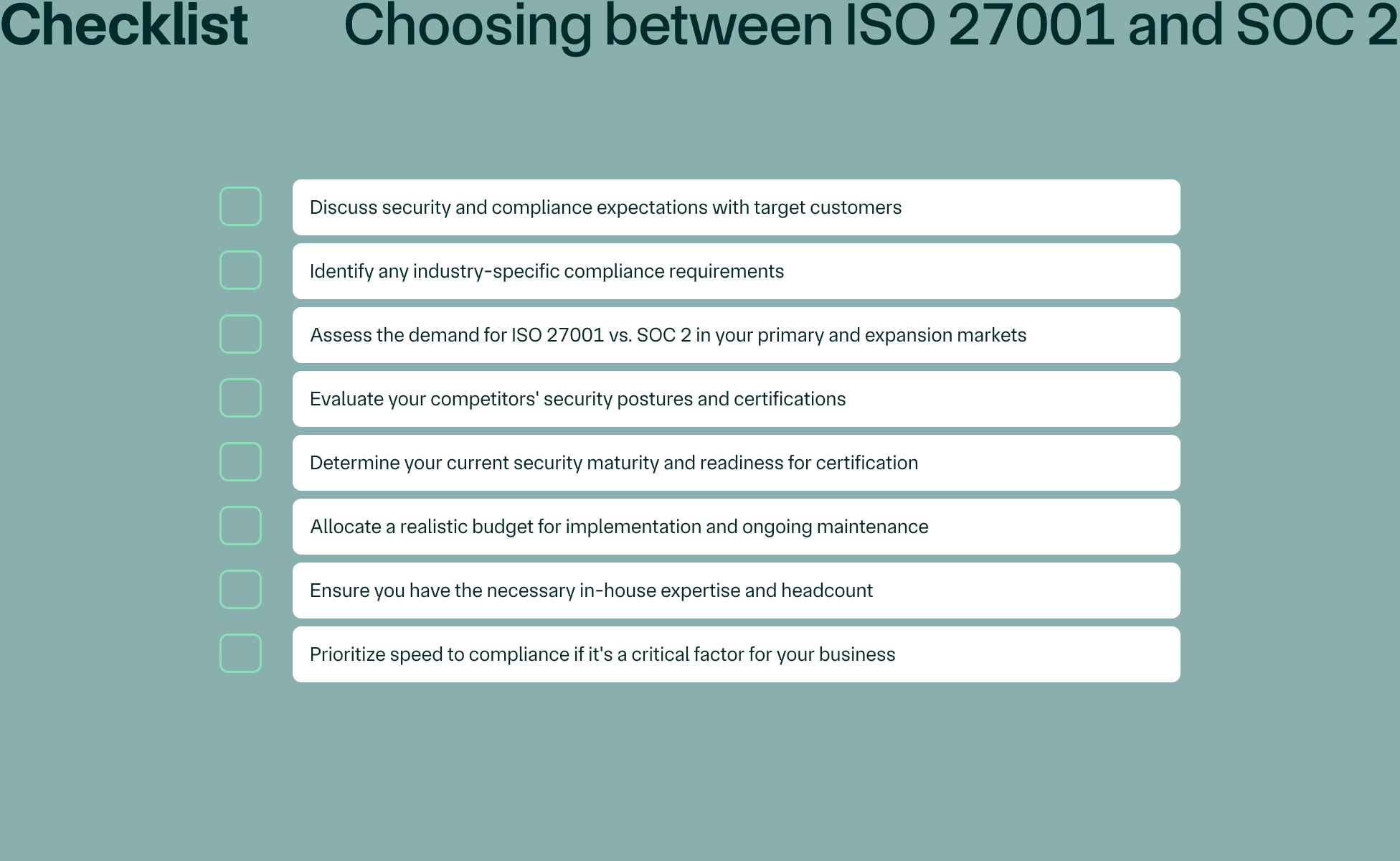
By working through this framework and checklist, startups can make a well-informed decision on whether to pursue ISO 27001 certification or SOC 2 attestation - or in rare cases, both.
How to build security that enables either path
Circling back to the original question: Should your startup pursue ISO 27001 or SOC 2? The truth is, startups should avoid an either/or mentality between ISO 27001 certification and SOC 2 compliance. Instead, the goal should be to establish a strong, unified security foundation that can enable either path (or potentially both), depending on the evolving needs of the business.
Mycroft takes a "foundation-first" approach, working closely with startups to build a robust information security management system (ISMS) aligned with industry best practices. By proactively implementing comprehensive controls and instilling a security-first mindset, startups can position themselves for a smoother, more cost-effective journey towards certification and compliance, whether that's ISO 27001, SOC 2, or even both.
At Mycroft, we strongly believe cultivating unified security, not piecemeal compliance, is the key to long-term resilience against evolving threats. With a solid security foundation in place, startups can keep their options open and focus on the certification that best fits their current and future needs.
Book time with an expert to learn more
Frequently asked questions about ISO 27001 vs SOC 2
Is ISO 27001 better than SOC 2?
Neither framework is inherently "better" - they serve different purposes. SOC 2 focuses on operational controls for service organizations and dominates the US market. ISO 27001 takes a broader governance approach and is preferred internationally. For US startups, SOC 2 Type II is usually the better choice because it meets customer expectations and integrates with other US compliance frameworks.
Do I need both ISO 27001 and SOC 2?
Most US startups don't need both. Pursuing dual certification drains resources through duplicate audits, conflicting requirements, and higher costs without proportional benefits. Focus on SOC 2 for the US market unless you have immediate international expansion plans or specific customer requirements for ISO 27001.
Which is easier: ISO 27001 or SOC 2?
SOC 2 is generally easier for startups. It has a faster timeline (3-6 months vs 6-12 months), lower costs, and more streamlined requirements focused on operational controls. ISO 27001 requires implementing a comprehensive ISMS with extensive documentation, risk assessments, and management reviews that demand more resources and time.
What's the difference between ISO 27001 and SOC 2?
SOC 2 evaluates how service organizations control customer data through five trust services criteria (security, availability, processing integrity, confidentiality, privacy). ISO 27001 establishes a comprehensive information security management system across the entire organization. SOC 2 is operational and US-focused; ISO 27001 is governance-oriented and internationally recognized.
Should startups choose ISO 27001 vs SOC 2 based on geography?
Yes, geography matters significantly. US enterprise customers expect SOC 2 compliance as standard. European and Asian markets often prefer ISO 27001. If you're primarily selling to US enterprises, choose SOC 2. If you're targeting international markets from the start, consider ISO 27001. Most startups should start with their primary market's preferences.