
Managed compliance services: Why the traditional model is broken (and what actually works)

You tried the DIY compliance route. You signed up for Vanta or Drata, thinking automation would solve your SOC 2 problem. Six months later, your engineering team is still buried in screenshot requests, your policies need constant updates, and you're realizing the "automated" platform still requires someone to run it full-time.
So you start looking at managed compliance services. Maybe outsourcing this whole mess makes sense
But here's what most articles about managed compliance won't tell you: The traditional managed services model is just as broken as the DIY approach. You're essentially paying $200K-500K annually for consultants to do manual work that still requires extensive coordination from your team.
There's a better way. But first, you need to understand why the current options are failing.
What are managed compliance services?
Simple definition: Managed compliance services
Managed compliance services are third-party providers that handle security and regulatory compliance operations on your behalf. Rather than building and maintaining compliance programs internally, organizations outsource this function to specialized firms.
Traditional managed compliance services provide typical deliverables including:
- Compliance program setup: Risk assessments, identifying compliance gaps (gap assessments), policy development, control implementation
- Audit preparation and management: Evidence collection, auditor coordination, remediation tracking
- Ongoing compliance monitoring and maintenance: Quarterly control testing, annual policy reviews, employee training
- Documentation management: Security documentation, vendor questionnaires, customer security reviews, financial reporting documentation
The value proposition: Your team focuses on building your product while compliance experts handle the security and regulatory compliance requirements needed to close enterprise deals. In practice, however, most managed compliance services operate more like expensive project management than true operational outsourcing.
Three traditional models (and their limitations)
Most organizations evaluating managed compliance services encounter one of these three models. Each has a specific use case where it works. But, for most growing companies, they all share the same fundamental problems.
1. Compliance-as-consulting
What it is: Firms like Big Four accounting practices or specialized boutique consultancies that assign compliance specialists to guide your compliance program.
What they promise:
- Expert guidance through your first SOC 2 / ISO 27001 / HIPAA certification
- Best practice frameworks and templates
- Smooth audit process with their auditor relationships
What you actually get:
- $150K-300K for initial certification, $75K-150K annually for maintenance
- Consultants who know compliance frameworks but may not understand your specific infrastructure
- You still do most of the actual work - your team implements controls, collects evidence, and maintains documentation
- When consultants rotate off your account (and they will), context gets lost
Best fit for: Large enterprises with dedicated compliance teams who need strategic guidance, not operational support.
2. GRC platform + implementation services
What it is: Vendors like Vanta, Drata, or SecureFrame that bundle their software with "white glove" implementation and support.
What they promise:
- Automated evidence collection
- Fast path to certification (90 days!)
- Continuous monitoring post-audit
What you actually get:
- $20K-50K annually for software, plus $15K-40K for implementation
- A checklist of 100+ controls that still need someone from your team to complete
- Integrations that work until vendor APIs change and break
- Support that helps you use their tool, but doesn't actually do the work
- Your security engineer becomes a full-time GRC administrator
Best fit for: Teams with dedicated security headcount who want tooling to make their existing compliance work more efficient.
3. Traditional MSSP (Managed Security Service Provider)
What it is: Security operations firms that add compliance management as an additional service line.
What they promise:
- End-to-end compliance management
- 24/7 monitoring and support
- Integration with their SOC/MDR services
What you actually get:
- $200K-500K+ annually for comprehensive services
- 6+ months onboarding and integration time
- Separate vendors for GRC, cloud security, device management, application security - you still need to coordinate between them
- Compliance delivered as a service, but your actual security posture is still your problem
Best fit for: Large organizations that already have MSSPs and need compliance added to existing security operations.
Why do traditional managed compliance services fall short?
I've watched hundreds of companies go through this cycle: They outsource compliance to save time and resources, only to discover they've traded one set of problems for another. Here are the five reasons traditional managed compliance consistently fails to deliver on its promises:
The pricing model doesn't align with value
Traditional managed compliance services charge like consultants - by the hour or by retainer. You're paying for labor, not outcomes.
A Big Four firm might charge $300K for your initial SOC 2, with $100K annually for maintenance. That's multiple full-time security engineer salaries - except you're not getting a dedicated team member, you're getting timesheets.
When your consultant works on your competitor's compliance program that same week, how much institutional knowledge are they really building about your specific environment?
You're still the integration point
Even when you hire managed compliance services, your team becomes the coordinator between the compliance consultants who need evidence, the auditors who have questions, the various security tools generating alerts, the engineering team implementing changes, and the business stakeholders who need to sign policies.
You haven't outsourced compliance. You've added another vendor to manage.
The manual work doesn't scale
Traditional services are fundamentally manual. A consultant reviews your AWS configuration and writes findings in a spreadsheet. A month later, your infrastructure has changed, but the spreadsheet hasn't.
When you add new employees, new vendors, or new infrastructure, someone still needs to update policies, reconfigure controls, collect new evidence, coordinate testing, and notify stakeholders. That someone is either the expensive consultant (adding to your bill) or your already-stretched team.
The context problem
This is the silent killer of managed compliance programs.
Your consultant knows compliance frameworks. But do they know why that specific port is open (because of your partner integration)? Why you have that exception documented (because of your M&A activity)? Why you chose that particular control implementation (because of your technical constraints)?
This context usually lives in your CISO's or lead engineer's head. When they leave, or when your consultant rotates to another account, that context evaporates. You're left with a compliance program that works until something breaks - and no one remembers why it was built that way.
The security theater problem
Traditional managed compliance services optimize for passing audits, not for actual security. The consultant helps you implement the minimum controls needed to check the boxes. They're incentivized to get you through the audit efficiently, not to build a genuinely robust security program.
You end up with what the industry politely calls "security theater"—compliant on paper, vulnerable in practice. Then when a security incident happens, you realize your SOC 2 certification didn't actually protect you.
What to look for in modern managed compliance services
If you're going to outsource compliance, here's what actually matters:
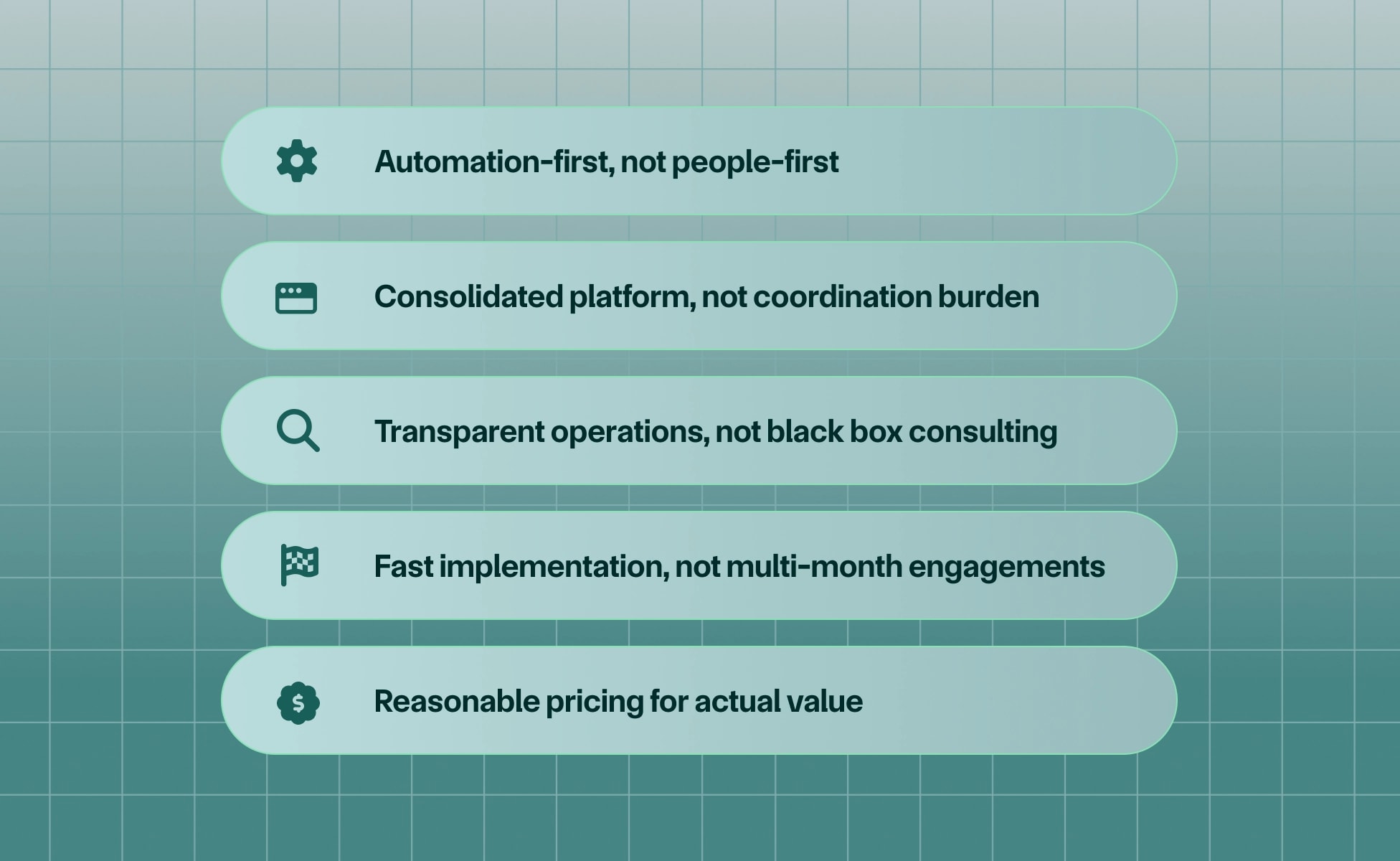
Automation-first, not people-first
Modern managed compliance should use technology to simplify compliance and eliminate manual work, not just have humans do that manual work on your behalf.
- Look for: Continuous automated evidence collection, AI-powered risk assessment, automated control testing, integration maintenance handled by the provider.
- Red flag: When the provider's answer to "how do you handle X?" is "our team will..."
Consolidated platform, not coordination burden
Your managed compliance provider should reduce your vendor stack, not add to it.
- Look for: GRC, cloud security, device management, and TPRM in one platform. Native integrations that the provider maintains. Unified risk dashboard.
- Red flag: When the provider says "we integrate with your existing..." for every security function.
Transparent operations, not black box consulting
You should have complete visibility into your compliance status, not just quarterly status reports.
- Look for: Real-time dashboard of your compliance posture, audit trail of every control test and evidence collection, direct access to the platform, clear documentation of how automation works.
- Red flag: When you can't log in and see the current state yourself.
Fast implementation, not multi-month engagements
If a managed compliance provider needs 6 months to onboard you, they're doing it wrong.
- Look for: Week-scale onboarding, pre-built frameworks and playbooks, minimal custom development required, clear timeline with specific milestones.
- Red flag: When the SOW talks about "discovery phase" and "customization sprints."
Reasonable pricing for actual value
Managed compliance should cost less than hiring the team to do it yourself—ideally, significantly less.
Do the math: One security engineer costs $150K-200K fully loaded. Traditional MSSP costs $200K-500K annually. GRC platform + implementation costs $35K-90K annually (but you still need that engineer).
If managed compliance costs more than internal headcount and still requires coordination from your team, what are you actually paying for?
The modern alternative: Risk operations as a service
There's an emerging model that addresses the fundamental flaws of traditional managed compliance services: risk operations as a service.
Instead of outsourcing compliance as a project or buying a tool you need to operate yourself, this model gives you a complete security and compliance operations team to reduce compliance risks—automated where possible, human where needed.
How risk operations as a service differs from traditional managed compliance
Traditional model:
- You buy consulting hours
- Consultant guides you through compliance
- Your team does the actual implementation
- Evidence collection is manual
- You coordinate between multiple security vendors
- Compliance program exists in spreadsheets and documents
Risk operations model:
- You get a platform plus operational support
- AI agents automate routine security tasks
- Implementation happens as part of onboarding
- Evidence collection is continuous and automated
- Security stack is consolidated in one platform
- Compliance program lives in an active, monitored system
What this looks like in practice:
For a founding CTO: You need SOC 2 to close enterprise deals, but you don't have security headcount and don't want to pull engineers off product work.
- Traditional managed compliance: Hire consultants for $200K who give your team a 100-item checklist to complete over 6 months.
- Risk operations as a service: Onboard to a platform in one week. AI agents handle control implementation, evidence collection, and continuous monitoring. Your team makes security decisions; the platform handles execution and maintenance.
For a security lead: You're managing compliance standards across multiple frameworks (SOC 2, ISO 27001, HIPAA) plus actual security operations (TPRM, vulnerability management, device management). Your team of three can't keep up.
- Traditional managed compliance: Hire an MSSP that specializes in compliance but doesn't handle your actual security operations. You still need separate vendors for cloud security, device management, TPRM.
- Risk operations as a service: Consolidated platform covering all security pillars - compliance, cloud security, device management, TPRM. One vendor, one dashboard, one team supporting you. Your security team focuses on strategic decisions, not administrative tasks.
Five core capabilities of risk operations as a service
Risk operations as a service isn't just a rebranding of managed compliance—it's a fundamentally different approach built on proactive risk management and five core capabilities that traditional services can't match.
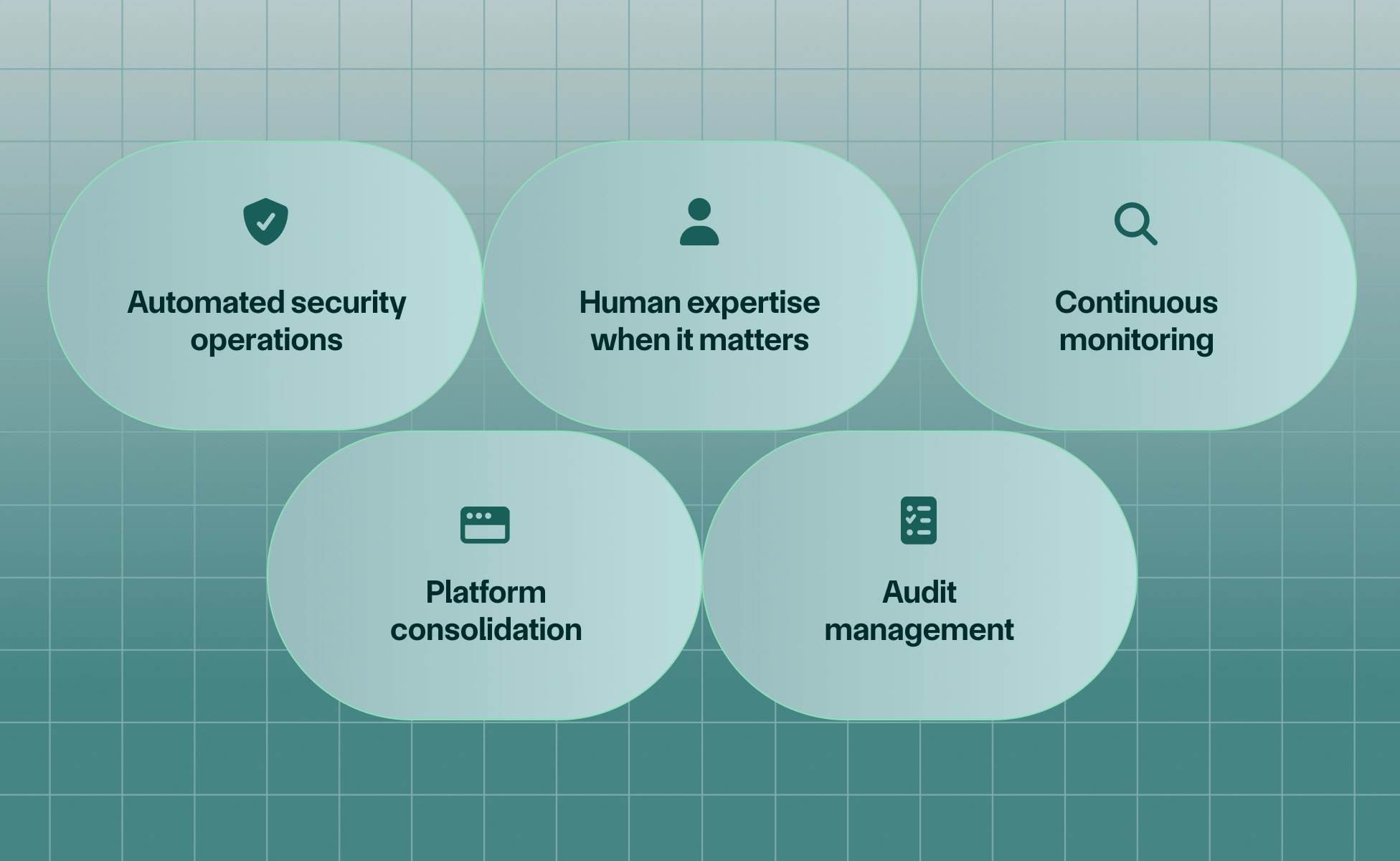
1. Automated security operations
AI agents handle control testing, evidence collection, policy updates, and routine security tasks that traditionally consumed hours of manual work.
This isn't simple workflow automation; these are intelligent agents that understand context, adapt to your environment, and continuously improve based on your organization's patterns. When a new employee joins, the system doesn't just check a box; it provisions accounts across your entire stack, assigns role-appropriate training, updates access controls, and documents everything for audit trail.
2. Human expertise when it matters
Automation handles the routine work, but complex security decisions still require human judgment. Security analysts are available for incident response and investigation, custom workflow design, and strategic guidance on risk decisions.
The difference: They're focused on problems that actually need human intelligence, not filling out spreadsheets or chasing down evidence. When you hit an edge case or need to make a risk acceptance decision, you have experts who understand both security and your specific business context.
3. Continuous monitoring
Real-time visibility into your security posture through continuous compliance replaces quarterly status reports and annual audits. Your compliance dashboard shows current state across all controls, not snapshots from weeks ago.
When your infrastructure changes, your compliance posture updates automatically. When a new vulnerability is discovered, you know immediately which systems are affected and what controls are in place. Traditional services tell you where you were; risk operations tells you where you are.
4. Platform consolidation
Replace 5-10 security tools with one integrated system that covers GRC, cloud security, device management, application security, and third-party risk management.
This isn't just about reducing vendor invoices: It's about having a unified view of your security posture where compliance controls map directly to actual security implementations. When your auditor asks about your vulnerability management process, you point to one system, not a patchwork of tools held together with manual workflows.
5. Audit management
The platform interfaces with auditors while giving you complete visibility into the process.
You're not shut out of your own compliance program; you can see every control test, every piece of evidence, every auditor request in real time. But you also don't have to manage the relationship, coordinate evidence requests, or translate between auditor requirements and your technical implementation. The Risk Operations team handles that translation layer while keeping you informed and in control.
The fundamental shift: You're not buying another tool to operate or hiring consultants to guide your team. You're buying operational capacity that happens to be delivered through technology plus human support.
Wondering which approach is right for you?
I've helped dozens of companies evaluate managed compliance providers, and the decision usually comes down to one question: Do you need someone to guide you through compliance, or do you need someone to actually run your compliance operations? Most articles won't tell you this, but those are fundamentally different services—and picking the wrong one is expensive. Here's how to think about your options:
You might still need traditional consulting if:
- You're a large enterprise with dedicated compliance teams who need strategic guidance
- You have highly specialized regulatory requirements and compliance mandates (financial services, healthcare organizations, government)
- Your compliance program is already mature and you need specific expertise
You should consider risk operations as a service if:
- You're a growing company (10-500 employees) that needs enterprise-grade security without enterprise headcount
- You're drowning in DIY compliance with tools like Vanta/Drata that still require too much manual work
- You need SOC 2/ISO 27001 to close deals but don't want to hire a dedicated security team yet
- You're coordinating between 5+ security vendors and it's becoming unmanageable
Questions to ask any managed compliance provider:
- "What percentage of the work is automated vs. manual?" - If they're proud of their "experienced consultant team," you're paying for expensive human labor.
- "How long does implementation take?" - If it's more than a month, they're doing consulting, not operations.
- "What happens when my team's point person leaves?" - If the answer involves "transition planning" and "knowledge transfer," context lives in humans, not the system.
- "Can I see my current compliance posture right now?" - If you can't log in and see real-time status, you don't have operations, you have periodic reporting.
- "What does this replace in my security stack?" - If it only handles GRC and you still need separate tools for cloud security, device management, and TPRM, you're not consolidating, you're adding.
Mycroft's Risk Operations Center: Managed compliance rebuilt for modern security
I spent years on both sides of the compliance industry—as an auditor watching companies struggle with inefficient processes, and as a practitioner running security programs that were drowning in manual work. The problem was obvious: Traditional managed compliance services were just moving manual labor from one organization to another, not actually solving the underlying problem.
We built Mycroft to address what I wish I'd had in those roles: a platform that uses AI to eliminate the manual work entirely, while keeping human experts focused on decisions that actually require judgment.
Consolidation + automation + strategic human support
One platform for your entire security stack:
- Audit and compliance covering critical compliance areas (SOC 2, ISO 27001, HIPAA, etc.)
- Cloud security (AWS, Azure, GCP scanning and monitoring)
- Application security (vulnerability assessment, code scanning)
- Device management (MDM, endpoint security)
- Third-party risk management (vendor assessments, continuous monitoring)
Instead of coordinating between Vanta for GRC, Wiz for cloud security, CrowdStrike for endpoints, and consultants for TPRM, you have one system that handles everything.
AI agents that actually do the work
Mycroft's agentic AI doesn't just collect evidence - it implements controls, monitors your environment, responds to security events, and manages ongoing compliance.
Example workflows our AI agents handle:
- Employee onboarding: Automatically provision accounts, assign training, update access controls, generate documentation
- Vulnerability remediation: Detect vulnerability, prioritize by business context, create tickets for appropriate teams, track to closure
- Vendor assessment: Collect security documentation, perform risk analysis, generate assessment report, flag changes
- Audit preparation: Gather evidence across all control domains, organize by framework, ensure audit readiness
The difference from GRC platforms like Vanta: Their automation helps you work faster. Our automation does the work.
Human experts for what matters
Our Risk Operations Center team includes compliance professionals: GRC analysts who manage your audit process, security engineers who handle complex incidents, forward-deployed engineers who build custom workflows, and audit coordination specialists who interface with your auditors.
You get strategic human support without paying $200/hour for someone to screenshot your AWS console. Our team handles the decisions that matter—risk assessments, custom workflow design, audit strategy, incident investigation. The AI agents handle the repetitive execution work that doesn't need human intelligence but has historically required human time. That's the economics that make modern risk operations work: Automation takes your cost structure down by 70-80%, and human expertise focuses on the 20% of work that actually creates value.
If you're tired of compliance being a resource drain and want to see what automated security operations actually look like, book a demo with our team.
FAQs
What are managed compliance services?
Managed compliance services are third-party providers that handle security and compliance obligations on behalf of an organization, including framework implementation, audit preparation, control testing, and ongoing compliance maintenance.
How much do managed compliance services cost?
Traditional managed compliance services typically cost $150K-300K for initial certification and $75K-150K annually for ongoing maintenance. Modern risk operations platforms like Mycroft cost significantly less by using automation to replace manual labor.
What's the difference between managed compliance and a GRC platform?
- GRC platforms (like Vanta or Drata) are tools you purchase and operate yourself - they help automate evidence collection but still require your team to do the work.
- Managed compliance services do the work on your behalf.
- Risk operations platforms like Mycroft combine both: Automated platform plus operational support.
Do I still need internal security headcount if I use managed compliance services?
It depends on the model.
- Traditional consulting services and MSSPs still require significant coordination from your team—someone needs to manage the relationship, provide context, implement their recommendations, and coordinate between your consultants and your business. You're essentially adding a vendor to manage rather than eliminating work.
- GRC platforms like Vanta or Drata reduce some administrative burden in compliance processes but still require dedicated security headcount to operate the platform, interpret findings, and maintain the program. Most companies using these tools discover they need at least one full-time security engineer to make them work effectively.
- Risk operations platforms like Mycroft are designed to minimize internal resources needed. They're ideal for companies that want enterprise-grade security without building a security team—founding CTOs who need SOC 2 to close deals, or small security teams (1-3 people) who want to focus on strategic security work rather than compliance administration. You still need someone to make security decisions for your organization, but the platform handles execution and maintenance.
What's included in Mycroft's Risk Operations Center?
Mycroft's ROC includes GRC management (SOC 2, ISO 27001, HIPAA, etc.), cloud security scanning, application security, device management, third-party risk management, AI agents for automation, and human security analysts for complex work - all in one platform.