
SOC 2 Type 2 compliance:
What it actually means

Most guides treat SOC 2 Type 2 as "Type 1, but longer." That framing misses the point entirely.
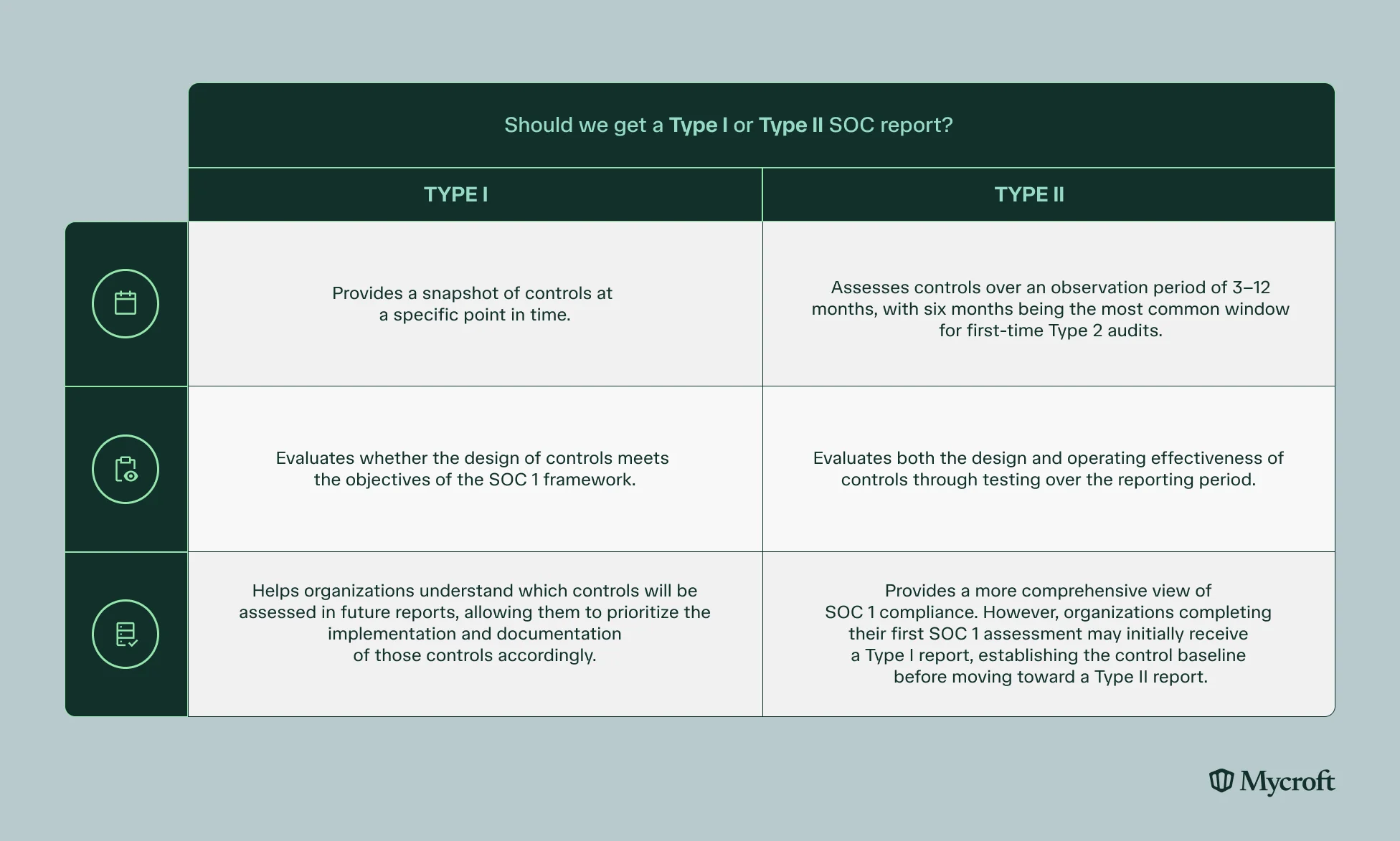
The jump from Type 1 to Type 2 isn't just a matter of extending your audit window. It's the jump from designing controls to proving they operate. And that's a fundamentally different challenge:
- Type 1 asks whether your controls exist and are suitably designed.
- Type 2 asks whether they actually work, consistently, for months, while your team ships product, onboards employees, manages vendors, and handles everything else that constitutes normal business operations.
That distinction changes everything about how you should prepare, what it costs, and where companies actually struggle. It's also the reason we built Mycroft.
What is SOC 2 Type 2?
SOC 2 (which stands for System and Organization Controls) Type 2 is an attestation report governed by the American Institute of Certified Public Accountants (AICPA). It evaluates the design and operating effectiveness of a service organization's internal controls over a defined observation period.
A few things to establish upfront, because the broader internet gets them wrong with alarming frequency:
- SOC 2 is an attestation, not a certification: Your auditor (a licensed CPA firm) issues an opinion on your controls. They don't hand you a pass/fail grade or a certificate to frame. You can receive an unqualified opinion (no material issues), a qualified opinion (exceptions noted), or worse. The distinction matters because it means SOC 2 reports have nuance. Enterprise buyers who actually read them (and the good ones do) understand this.
- SOC 2 is voluntary: There's no regulation requiring it.
- But "voluntary" is increasingly theoretical: Enterprise procurement teams now treat a current SOC 2 Type 2 report as table stakes for vendor evaluation. If you're selling SaaS, cloud infrastructure, or any service expected to protect customer data, the absence of a Type 2 report is a deal blocker for a growing segment of buyers—especially those managing their own exposure to data breaches across vendor ecosystems. SOC 2 isn't just a regulatory compliance exercise—it's a growth enabler. Your ability to close upmarket deals depends on having a current report.
- The "Type 2" designation is specifically about operating effectiveness over time: The auditor isn't just checking that controls are designed properly (that's Type 1). They're evaluating whether those controls functioned as intended throughout the observation period. Every control. Every month. With evidence.
SOC 2 Type 1 vs. Type 2: What's the actual difference?
The comparison table is straightforward. The implications are not.
| Type 1 | Type 2 | |
|---|---|---|
| What it evaluates | Design and implementation of controls at a single point in time | Design, implementation, and operating effectiveness over a sustained period |
| Observation period | None—snapshot audit | 3–12 months of continuous operation |
| What the auditor tests | Are controls suitably designed? Do they exist? | Are controls operating as intended? Is there evidence of consistent execution? |
| Common use case | First-time SOC 2, or bridge report while building toward Type 2 | Ongoing compliance, enterprise sales, mature security programs |
| Timeline to complete | 1–3 months (prep + audit) | 9–18 months (prep + observation period + audit) |
| What buyers expect | Acceptable as interim proof; some enterprise buyers will accept initially | The standard most enterprise buyers require |
The gap between Type 1 and Type 2 isn't just time; it's operational maturity:
- A Type 1 asks: "Do your controls exist?" You can assemble policies, configure tools, document procedures, and pass a Type 1 audit in a compressed timeline. It's a design exercise.
- A Type 2 asks: "Do your controls actually work, consistently, for months?" That's the difference between having an access review policy in a Google Doc and having a system that enforces, monitors, and documents that policy continuously—without someone manually holding it together. It's the difference between a vulnerability management program on paper and one that actually tracks remediation against defined SLAs across every scan, every month, for the duration of the observation period.
Most companies discover this gap during their first observation period, not before it. And by then, the clock is already running.
The five Trust Services Criteria (and how they apply to Type 2)
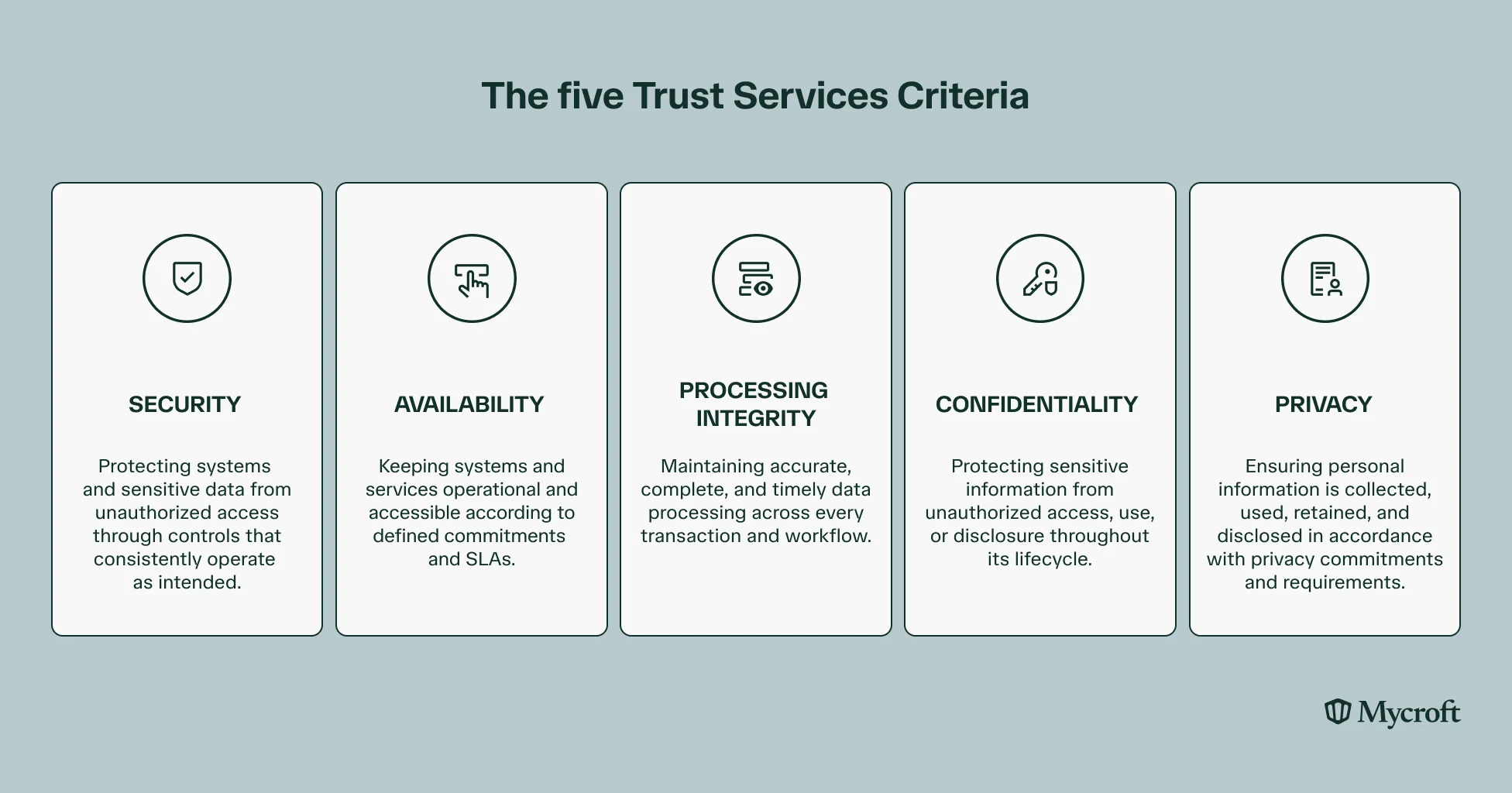
SOC 2 is built on the AICPA's Trust Services Criteria (TSC). Security is mandatory for every SOC 2 audit. The remaining four (Availability, Confidentiality, Processing Integrity, and Privacy) are optional, selected based on your services and customer commitments.
Every SOC 2 guide lists these criteria. Few explain what it actually means to prove ongoing operating effectiveness in each area—which is the whole point of Type 2.
Security
Protection of systems and sensitive data against unauthorized access. In a Type 2 context, this means demonstrating that access controls, intrusion detection, network monitoring, and incident response aren't just configured—they're actively functioning over the entire observation period.
An access review policy that says "quarterly" but was only executed twice during a six-month observation period is a finding. A firewall rule that was temporarily relaxed for a deployment and never tightened back is a finding. Type 2 doesn't care what your policy says—it cares what your team did.
Availability
Systems and services are operational and accessible per your commitments and SLAs. Type 2 requires evidence of uptime monitoring, capacity planning, incident tracking, and disaster recovery testing throughout the observation period. A DR plan that was tested once during readiness but never exercised during the actual observation window leaves a gap the auditor will notice.
Processing Integrity
Processing Integrity is ensuring your data is handled correctly, completely, and on time — every time. For SaaS, fintech, and data processing companies, mistakes in processing can have real consequences, making this one of the most critical trust service criteria to get right. During a Type 2 audit, auditors go beyond a snapshot; they review evidence across the full observation period, looking at things like error logs, reconciliation reports, and validation controls to confirm your systems held up consistently, not just on a good day.
Confidentiality
Data classified as confidential is protected throughout its lifecycle. In the Type 2 context, this means proving encryption, access restrictions, and data handling procedures are consistently applied—including during employee offboarding, which is one of the most common gaps. If someone left the company during the observation period and retained access to confidential systems for three weeks before the offboarding process caught up, that's a control failure the auditor can identify.
Privacy
Personal information is collected, used, retained, and disclosed in conformity with your organization's commitments and applicable criteria. Type 2 requires ongoing evidence that privacy controls operate as described: consent management is enforced, data retention policies are executed (not just documented), and breach notification procedures are in place and tested.
How to prepare for SOC 2 Type 2 compliance
This is where most SOC 2 guides go generic—a list of steps that could apply equally to Type 1 or Type 2. The preparation process for Type 2 is different in kind, not just degree, because everything you build has to sustain itself under real operating conditions for months.
Phase 1: Scoping and readiness assessment
Before anything else, define your scope. Which Trust Services Criteria apply to your services and customer commitments? Which systems, people, and processes are in scope? Getting this wrong creates problems downstream—either you're over-scoped (wasting effort on controls that aren't necessary) or under-scoped (and the auditor flags the gap).
Then conduct a readiness assessment: a structured dry run that identifies gaps in your controls, policies, and documentation before the formal observation period begins.
The readiness assessment is especially critical for Type 2 because once your observation period starts, gaps become findings. Unlike Type 1, where you can remediate and get audited the same month, Type 2 requires controls to be operating for the duration. Starting the observation period with unresolved gaps means either pausing (and restarting the clock) or accepting exceptions in your final report.
Ideal timing: Conduct the readiness assessment 3 to 6 months before you want the observation period to begin. The bigger the gaps, the more runway you need.
Phase 2: Controls design and implementation
Map your existing controls to the TSC requirements you've scoped. Identify what's in place, what's partially implemented, and what's missing entirely.
For Type 2, the implementation bar is higher than for Type 1. Every control needs more than documentation—it needs an operational mechanism. A way it will be executed, monitored, and evidenced over months without depending on a single person remembering to do it.
Key areas to address during implementation:
- Access management: Role-based access controls, regular access reviews, provisioning and deprovisioning procedures for joiners and leavers.
- Change management: A defined process for approving, testing, and deploying changes to production systems, with evidence that the process is actually followed.
- Incident response: A documented plan is the baseline. Type 2 demands evidence that the plan has been exercised, ideally through a tabletop exercise or documented handling of actual incidents.
- Vendor management: Third-party risk assessments for vendors in scope, with ongoing monitoring (not just a one-time evaluation at contract signing).
- Risk assessments: Not a static artifact created during readiness and forgotten. Type 2 auditors expect the risk register to reflect current business conditions.
- Vulnerability management: Regular scanning with documented remediation timelines and evidence of follow-through.
- Employee onboarding and offboarding: Security awareness training for new hires, timely deprovisioning for departures—consistently, every time, throughout the observation period.
- Device management: Especially relevant for remote and hybrid teams. MDM policies need to be enforced, not just configured.
Phase 3: The observation period—where Type 2 is won or lost
This is the phase most SOC 2 guides either gloss over or skip entirely. It's also the phase that determines whether your Type 2 report comes back clean or riddled with exceptions.
The observation period is the 3 to 12-month window during which your controls must demonstrably operate. The auditor will sample evidence from across this entire period. That means:
- If your access reviews are quarterly, all of them must be completed and documented—not three out of four
- If your vulnerability scans are monthly, every single month needs evidence of the scan and evidence of remediation activity
- If your change management process requires approvals, every production change during the period needs the approval chain documented (including the ones that shipped at 11 PM on a Friday)
- Every employee who joined or left during the period needs to show proper onboarding or offboarding evidence
Controls that look solid in a readiness assessment fall apart under the weight of real operations. I've seen it dozens of times:
- The person responsible for quarterly access reviews goes on vacation, and nobody backfills the task
- The engineer handling vulnerability remediation gets pulled onto a product sprint
- The compliance lead burns out by month four from manually chasing approvals through Slack
The core challenge of Type 2 isn't whether you can design good controls—it's whether your team can operate them consistently for six or twelve months without the entire program living in one person's head. The companies that get through cleanly are the ones that built operational infrastructure before the clock started. The ones that struggle treated a GRC checklist tool as a substitute for that infrastructure, and discovered too late that it gave them a task list but not the capacity to execute it.
Phase 4: The audit period itself
Once the observation period concludes, the formal audit begins. The auditor (an independent CPA firm) will:
- Sample evidence from across the observation period: They won't review every access review or every change request, but they'll pull samples designed to test whether controls operated consistently, not just at convenient moments.
- Conduct walkthroughs of key processes: Expect the auditor to interview control owners, review system configurations, and trace specific transactions or events through your control environment.
- Test operating effectiveness: This is what distinguishes the Type 2 audit from a Type 1. The auditor is specifically looking for evidence that controls functioned as intended throughout the period—and for evidence of failures or gaps.
The audit typically takes 4 to 6 weeks, depending on scope and complexity.
Possible SOC 2 Type 2 audit outcomes:
- Unqualified opinion: The auditor found no material issues. This is the target. It means your controls are suitably designed and operated effectively throughout the observation period.
- Qualified opinion: The auditor noted exceptions. Specific controls didn't operate as intended, or evidence was insufficient for certain areas. A qualified opinion isn't necessarily a dealbreaker with customers, especially if you have a clear remediation plan, but it does invite scrutiny.
- Adverse opinion: Material control failures were identified. This is rare and signals serious problems with the security program.
- Disclaimer of opinion: The auditor was unable to obtain sufficient evidence to form an opinion. This typically indicates significant cooperation or access issues during the audit.
Common gaps that surface during the Type 2 observation period
These are the gaps I see surface repeatedly across Type 2 audits—the operational failures that readiness assessments rarely catch because they only become visible over time.
- Access reviews documented in policy but not executed on schedule: The quarterly review happened in Q1 and Q3 but was skipped in Q2 because the person responsible was on leave. Nobody backfilled the task. That's a finding.
- Vulnerability management without centralized tracking or remediation SLAs: Scans are running monthly, but remediation isn't tracked against defined timelines. Critical vulnerabilities sit open for months because they're buried in a tool nobody checks regularly. The scan happened—but the response didn't.
- Third-party risk assessments that are one-and-done: The initial vendor assessment was thorough. Then the vendor's SOC 2 report expired, their security posture changed, and nobody noticed because there's no ongoing monitoring or reassessment process in place.
- Incident response plans that exist on paper but haven't been exercised: A tabletop exercise was planned for Q2 but kept getting bumped. By the time the observation period ends, there's no evidence that anyone on the team has actually walked through the response procedures.
- Change management approvals that bypass the defined process: Under time pressure, developers deploy directly to production. The approval is either skipped or documented retroactively. The auditor sees the deployment timestamp and the approval timestamp—and notices the approval came after the fact.
- Device management gaps in remote and hybrid environments: MDM policies are configured, but enforcement is inconsistent. A contractor's personal device was never enrolled. A departing employee's laptop wasn't wiped for three weeks after their last day.
- Risk assessments that are static: The risk register was created during the readiness phase and hasn't been updated since—even though the company acquired a new vendor, expanded into a new market, or migrated infrastructure during the observation period.
The pattern across these gaps is one I've seen in every engagement: Teams don't fail because they don't care about data security. They fail because their security operations are fragmented across too many disconnected tools, with no central context about whether the program is actually running. The Type 2 observation period doesn't reveal a controls problem; it reveals an operations problem. And in my experience, you can't solve an operations problem with a better checklist.
How much does SOC 2 Type 2 cost?
The short answer most guides give you: somewhere between $20,000 and $100,000+. That's technically accurate and practically useless, because it lumps together costs that behave very differently and skips the biggest one entirely.
The cost breakdown
- Audit fees: The CPA firm conducting your Type 2 audit will typically charge between $15,000 and $50,000, depending on your scope (number of Trust Services Criteria), the complexity of your infrastructure, the size of your organization, and the firm itself.
- A note on audit quality: Firms that promise speed and low cost may deliver a report that satisfies the letter of the requirement but doesn't hold up to scrutiny from sophisticated enterprise buyers who actually read reports. The auditor's reputation and rigor matter.
- Readiness assessment: If you engage a consultant or advisory firm for the readiness assessment, expect $5,000 to $20,000 depending on scope and depth.
- Note: Self-assessments are cheaper but carry higher risk of missed gaps that surface later during the observation period—when they become findings rather than remediation items.
- Tooling and platform costs: GRC platforms typically run $10,000 to $50,000+ per year. Additional security tools—vulnerability scanners, MDM solutions, SIEM or log management, access review platforms—add to the stack. The total tooling cost depends on how much you already have in place versus what needs to be implemented for SOC 2 readiness.
The cost nobody talks about: Operational overhead
This is where the real expense lives, and it's the part I wish someone had been more honest about when I was on the implementation side.
The audit fee is a line item. The platform subscription is a line item. But the operational burden on your team during the observation period: That's the cost that never shows up in a vendor quote. Here are a few examples I've seen:
- Engineering time diverted to evidence collection
- A compliance lead spending 30% of their week manually managing GRC workflows instead of doing strategic work
- Developers interrupted to provide screenshots, approve change requests, or complete access review tasks
I've watched teams lose months of product velocity to compliance tasks that should have been automated or handled by specialists.
A $15,000 readiness assessment that reveals you need $50,000+ in fragmented point solutions, plus a dedicated compliance person at $100,000+ fully loaded, plus meaningful engineering time pulled from product work—that changes the ROI calculation entirely.
The total cost of SOC 2 Type 2 isn't the audit. It's the operating model required to pass it and sustain it year over year.
How long does SOC 2 Type 2 take?
Setting realistic timeline expectations matters, because the compressed timelines some vendors advertise create misaligned expectations that cause real problems downstream.
- Readiness phase: 2–6 months. Depends on your current security maturity, the number of TSC in scope, and how many gaps the readiness assessment surfaces. Companies with existing security programs and some documentation in place will move faster. Companies starting from scratch need the full runway.
- Observation period: 3–12 months. Six months is the most common observation window for first-time Type 2 audits. Some enterprise buyers prefer or require a 12-month observation period. You cannot compress this—the observation period is the entire point of Type 2. It has to reflect real operating conditions over a meaningful duration.
- Audit: 4–6 weeks. Once the observation period concludes, the formal audit and report issuance typically takes four to six weeks, depending on the firm and the complexity of the engagement.
- Total from zero: 9–18 months from the decision to pursue SOC 2 Type 2 to a completed report in hand.
The timeline compression you see advertised ("SOC 2 in weeks!") refers to Type 1, not Type 2. A well-prepared team can achieve a Type 1 rapidly because there's no observation period. Type 2 is structurally different. What you can compress is the readiness phase (through better tooling and experienced guidance) and the audit itself (through clean, well-organized evidence). But the observation period is fixed. For a more detailed breakdown of each phase, see How long does SOC 2 take?
This is something I tell every company we work with: The teams that approach SOC 2 as a strategic maturity investment (rather than scrambling because a prospect asked for a report) consistently get better outcomes.
I've been on both sides of this: When you start early, you build operational muscle during the observation period. When you start late, you're bolting on a compliance program under pressure, and that's how you end up with exceptions in your report and an auditor asking uncomfortable questions.
Choosing your approach: DIY, consultant, platform, or managed operations
There are four broad approaches to SOC 2 Type 2, each with real trade-offs. The right choice depends on your team's capacity, your existing security maturity, and how much of the operational burden you can absorb internally.
| Best for | Strengths | Limitations | |
|---|---|---|---|
| Self-assessment / DIY | Teams with existing GRC expertise and available bandwidth | Cheapest upfront; full internal control | Slowest path; highest risk of gaps surfacing during audit; compliance lead carries entire program |
| Consultant / auditor advisory | Companies wanting high-confidence alignment with audit expectations | Direct expertise; auditor-perspective guidance | Engagement ends after advisory phase; you still operate the program day-to-day |
| Platform-only (automated GRC tool) | Teams with someone to own execution on an ongoing basis | Automates evidence collection and policy management; structured workflows | The underlying work—remediating gaps, managing workflows, chasing approvals—still falls on your team. The tool provides a task list, not the capacity to execute it. |
| Platform + managed operations (Risk Operations Center) | Teams without dedicated security headcount, or where the compliance lead is already stretched | Combines automation with human expertise; forward-deployed GRC engineers implement alongside you and manage the auditor relationship | Higher "sticker" cost than platform-only; requires trust in an external partner to operate critical functions |
The decision often comes down to a simple question: Do you have the team to operate a compliance program consistently for six to twelve months? If the honest answer is no, that's not a failure—it's the problem that Mycroft was built to solve.
Beyond the audit: Maintaining SOC 2 Type 2 compliance year over year
This is the part most SOC 2 guides treat as an afterthought—a closing paragraph that says "keep monitoring" and links to a product page. The reality is more consequential than that.
SOC 2 Type 2 isn't a milestone. It's a continuous operating state.
After your first Type 2 report, the cycle repeats. Your next audit covers the next observation period. Every control that operated effectively in year one needs to operate effectively in year two. And everything that worked (or didn't) carries forward. A control that passed this year but degrades next year becomes a finding in the next report.
The companies that struggle with renewals are always the ones where the program depended on one person. I've seen clean reports turn qualified in a single cycle because of it.
Sustainable Type 2 compliance requires centralized context: Your GRC data, vulnerability scans, third-party risk assessments, device management, and access reviews all feeding into a single operational view so that anyone can understand the state of your security posture at any time. Not just the person who set it up. Not just the person who happens to remember where the evidence lives.
This is exactly why we built Mycroft. Our Risk Operations Center is designed to make your security program an organizational capability rather than a personal one—combining the platform with forward-deployed GRC engineers who implement and operate alongside your team. The compliance program should survive any single person walking out the door. If it can't, the architecture is the problem, not the people.
See how Mycroft runs your SOC 2 Type 2 program
FAQs
No. SOC 2 is a voluntary standard developed by the AICPA. However, enterprise buyers increasingly treat a current SOC 2 Type II report as a prerequisite for vendor selection. For companies selling to mid-market and enterprise customers, it's functionally required even if it's not legally mandated.
Yes. Type 1 is not a prerequisite for Type 2. Some companies start with Type 1 as a bridge—to satisfy an immediate customer request while building toward Type 2. Others skip directly to Type 2 if they have the maturity and timeline to support the observation period. The right choice depends on whether you need a report now (Type 1 as a bridge) or can afford to wait for the more comprehensive proof that Type 2 provides.
SOC 1 evaluates controls relevant to financial reporting—it's designed for service organizations responsible for safeguarding financial data that affects their clients' financial statements (payroll processors, financial institutions, etc.). SOC 2 evaluates controls relevant to security, availability, processing integrity, confidentiality, and privacy. Most SaaS and cloud companies need SOC 2, not SOC 1. Some organizations (particularly in fintech) pursue both.
There's no formal expiration date. However, reports cover a specific observation period, and enterprise buyers generally expect a report that is less than 12 months old. Most organizations conduct annual audits to maintain a current report, which means the next observation period begins as the previous one ends—creating a continuous compliance cycle.
There is no pass/fail system. The auditor issues an opinion based on their evaluation. An unqualified opinion means no material issues were identified. A qualified opinion means exceptions were noted—specific controls didn't operate as intended or evidence was insufficient in certain areas. A qualified opinion isn't necessarily a dealbreaker for prospects, but it does invite questions. The goal is an unqualified opinion with a clean report.
Continuously, not annually. The entire Type 2 model is built on ongoing operations. Treating readiness as a once-a-year exercise is how gaps accumulate between audit cycles. Effective programs maintain continuous visibility into their control environment, catching deviations in real time rather than discovering them during the next audit.