
What's the most efficient way to handle CMMC compliance assessments?

TLDR:
- CMMC assessments fail when they’re treated as a one-time project versus an ongoing program.
- Efficient assessments follow a five-step framework, regardless of team size or security maturity.
- The right CMMC program runs continuously between assessments, so there’s no recertification scramble.
For most defense contractors, a Cybersecurity Maturity Model Certification (CMMC) compliance assessment feels exactly like a fire drill: Urgent, high-stakes, and driven almost entirely by how close the assessor's appointment is rather than how well the team prepared. Evidence is scrambled together. Approval signatures are chased down. Months of security operations get reconstructed in the final weeks before the Certified Third-Party Assessor Organization (C3PAO) arrives. That pattern is fixable, and the contractors who move through CMMC assessments quickly stop treating compliance as a one-time project.
There is real urgency now. The CMMC 2.0 framework was codified under 32 CFR (Code of Federal Regulations) Part 170, effective December 16, 2024. Under 48 CFR, effective November 10, 2025, those requirements were embedded directly into active DoD contract language—making a third-party assessment via a C3PAO a prerequisite for award, not a future obligation. For Level 2 contractors handling controlled unclassified information (CUI), non-compliance doesn't trigger a remediation plan. It makes you ineligible. Full stop.
This article walks through the five operational steps that make CMMC compliance assessments more efficient and what to do when you don't have a dedicated security team to run them.
What is a CMMC compliance assessment?
A CMMC compliance assessment is the formal evaluation process through which a defense contractor demonstrates that its cybersecurity controls meet the requirements of the applicable CMMC level—a mandatory prerequisite for bidding on or retaining Department of Defense (DoD) contracts that involve CUI, sensitive defense data.
CMMC 2.0 has three certification levels. The CMMC level that applies to your organization determines which security controls you need to implement, what the assessment process looks like, and how resource-intensive the overall certification process will be.
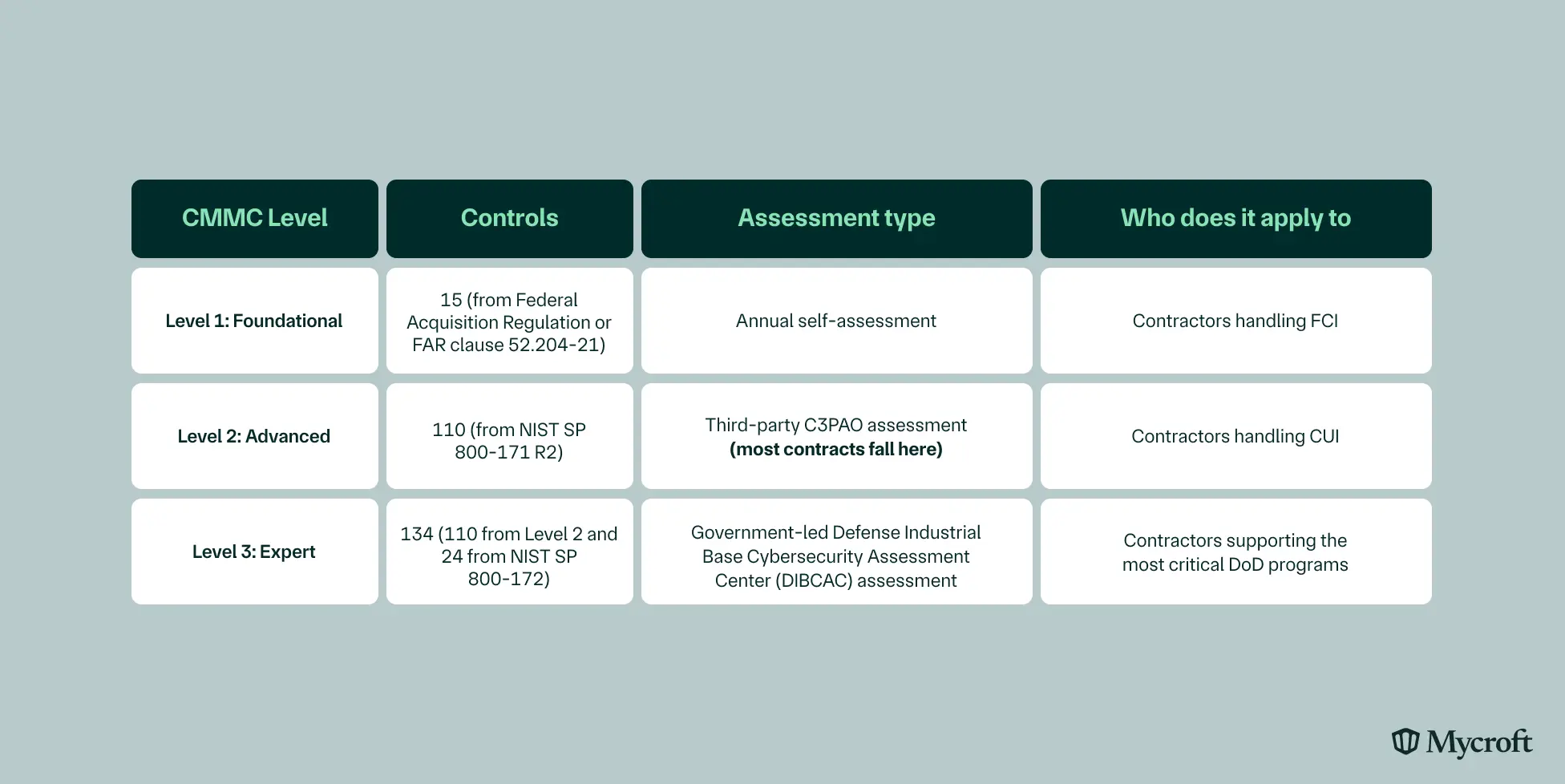
Most contractors in the defense industrial base (DIB) fall under Level 2. And a poorly run assessment at this level is most likely to stall, expand in scope, or fail outright.
Why is the CMMC assessment process so demanding?
When it comes to Level 1, an annual self-assessment is manageable for most teams, but Level 2 is an entirely different story. Several factors make CMMC assessments genuinely hard to run efficiently:
The binary nature of the certification process
C3PAOs evaluate whether your controls operate effectively, not just whether they’re documented. All Level 2 110 NIST SP 800-171 (National Institute of Standards and Technology Special Publication) Revision 2 (R2) controls must be fully implemented. There is no partial credit.
The C3PAO assessor capacity
The pool of accredited assessors hasn’t kept pace with contractor demand. As of fall 2025, only 431 CMMC 2.0 certifications had been awarded, with 104 Level 2 assessments in progress. According to CyberSheath’s analysis of the Cyber AB October 2025 Town Hall, each C3PAO would need to complete roughly 118 assessments per month to meet demand before the second enforcement phase begins on November 10, 2026. Starting assessment prep earlier means getting in line sooner, too.
The internal ownership gap
Who in the organization actually owns the CMMC assessment process? For many small and mid-size defense contractors, the CMMC assessment has no clear owner for months—and that ambiguity costs time and money.
The paper security trap
Many contractors have written procedures, security policies, and documented controls that have never been tested against real operational conditions. Data breaches and security incidents don’t care whether your policies are documented. Assessors find the gap quickly. As I tell every team I work with:
“Compliance is a side effect of having good security practices, not the other way around.” — Mike Kim, CEO and Founder, Mycroft
The contractors who try to build compliance first almost always have to go back and rebuild the security program underneath it.
Common pitfalls: What most CMMC assessment approaches get wrong
Inefficiencies in CMMC compliance assessments often stem from the following four recurring failures. Each one is preventable. Most are entirely predictable. And every one of them adds time, cost, or both to an assessment that didn't need to be complicated.
Treating it as a documentation project
When evidence collection is treated as an assessment-prep activity rather than an ongoing compliance effort, the C3PAO becomes a deadline, and everything before it becomes a mad scramble. Teams can spend the weeks before the official assessment hunting screenshots, chasing approval signatures, and writing procedures they should have had in place for the past year.
The problem isn’t just the scramble. It’s what it signals. When assessors encounter unsigned policies, screenshots without timestamps, and access logs not mapped to specific controls, they don’t take the documentation at face value. They probe harder. Timelines extend. Assessment scope expands. And before you know it, a plan of action and milestones (POA&M) is required to address gaps the team didn’t have time to close.
Operational evidence or verifiable evidence produced automatically as a byproduct of how you run security compresses all of this. But it only exists if the initial assessment began long before the C3PAO scheduled their first call.
Skipping scope definition
Defining the CUI boundary is the single highest-leverage step in CMMC compliance. It’s also one of the first things to slip when a team is moving fast. Your CUI scope determines your applicable CMMC level, which systems are in scope, how many controls you need to implement, and how long your assessment engagement will run.
Over-scoping is expensive. Under-scoping is risky: Assessors can expand your scope mid-assessment if they identify CUI-adjacent systems you didn’t account for. The effort to minimize risk here is spent up front, not scrambled together later.
CUI boundary definition should involve multiple departments, in addition to IT. Legal, operations, and program management typically know where CUI travels in ways the IT department alone doesn’t. For prime contractors, this is also where supply chain accountability comes into play. Prime contractors are responsible for their subcontractors’ CMMC posture. Waiting to define subcontractor obligations creates a downstream scramble that can delay your assessment timeline, even when your internal environment is ready.
If you're also evaluating compliance platforms, CMMC compliance platform: What to look for now that 48 CFR is in effect covers how CUI scoping affects your platform decision.
Underestimating the operational burden
Governance, risk management, and compliance (GRC) platforms automate evidence collection. What they don’t or can’t do is make remediation decisions, manage the C3PAO relationship, or own the program between certification cycles. The gap between what compliance software does and what a functioning compliance program requires is substantial.
Here’s a pattern that shows up consistently: A team purchases a compliance platform, completes onboarding, and gradually deprioritizes ongoing maintenance as the product roadmap takes over. Six months later, the evidence trail is stale, and controls have drifted from their documented state. Nobody flagged it because nobody owned it.
This is also where tool sprawl compounds the problem. Most defense contractors arrive at CMMC with five to seven fragmented security tools already in place. Adding a GRC platform on top doesn't consolidate that stack; it adds another dashboard to manage and another integration to maintain. The teams that struggle most with CMMC operational burden aren't under-tooled. They're over-tooled and under-resourced. If that sounds familiar, "How to eliminate security tool sprawl" covers how to consolidate before assessment prep begins.
Assuming another framework covers it
ISO 27001 and SOC 2 certifications signal strong security maturity. Neither maps directly to CMMC Level 2’s 110 NIST SP 800-171 R2 controls.
Contractors who’ve recently completed ISO 27001 or SOC 2 Type II often assume the conceptual overlap gives them a meaningful head start. It does, but only partially. ISO 27001 shares structural similarities with several CMMC domains (for a full side-by-side breakdown, see ISO 27001 vs. CMMC), while SOC 2 controls address some of the same risk management principles. But the control specificity, evidence requirements, and assessment scope are fundamentally different. What satisfies an ISO auditor won’t necessarily satisfy a C3PAO.
This is one of the more expensive assumptions to correct late in the process. Remediation timelines expand. Evidence packages have to be rebuilt against a different standard. The contractors who discover the gap two months before their assessment date are in a significantly harder position than those who mapped it at the outset.
What an efficient CMMC certification looks like: A 5-step operational framework
The contractors who breeze through CMMC compliance assessments share a common pattern: They didn’t treat certification as a one-time project. They built a compliance program, and the assessment was a natural outcome of how that program operated. The framework below is how they did it. These steps apply whether you have a full security team or none at all.
Step 1: Define your CUI boundary before anything else
Before any gap assessment, before any tool selection, before any policy writing: Define your CUI scope. Identify which systems, processes, and people touch controlled unclassified information. Document the boundary formally and get it reviewed.
Scope reduction is one of the most reliable efficiency levers available to most defense contractors. A tighter, well-defined CUI boundary means fewer systems in scope, fewer controls to implement, and a shorter assessment engagement. It’s step zero in the CMMC certification process.
It’s important to note that subcontractor compliance obligations should also be identified and documented at this stage. Getting ahead of supply chain requirements prevents a downstream scramble from delaying your own timeline.
Step 2: Run a gap assessment against CMMC requirements
Map your current cybersecurity posture against the applicable CMMC requirements—15 controls for Level 1 per FAR clause 52.204-21, 110 NIST SP 800-171 R2 controls for Level 2, or 134 controls for Level 3 (110 controls from Level 2 plus 24 NIST SP 800-172 controls). This gap assessment is your pre-assessment baseline.
Prioritize gaps by risk level and remediation effort. Regular risk assessments throughout the program lifecycle, not just at kickoff, keep the baseline up to date. High-risk, low-effort gaps should be closed first: They build momentum and address the most critical vulnerabilities before the initial assessment conversation begins. Document the gap assessment formally. Assessors respond well to organizations that can demonstrate they proactively identified and addressed their own deficiencies before the official assessment began.
Step 3: Control implementation with evidence built in
Control implementation and evidence collection should happen simultaneously, not sequentially. If a technical control requires a specific system configuration, that configuration should automatically produce a log, output, or record that serves as verifiable evidence.
AI automated tools—specifically, integrations between your security tooling and your GRC platform—significantly compress the assessment window. Assessors receive a clean, current, traceable evidence package rather than documentation that’s manually cobbled together. AI agents don’t just collect evidence; they implement controls directly across your infrastructure, so the gap between what's documented and what's operating closes automatically. The CMMC certification process rewards organizations that demonstrate controls operating continuously over time, not those reconstructing operations from a snapshot.
Step 4: Implement continuous monitoring before your C3PAO arrives
Continuous monitoring is a CMMC requirement that appears across multiple control domains per NIST SP 800-171 R2, including Audit and Accountability, Configuration Management, and System and Information Integrity. It also happens to be the clearest pre-assessment signal you have.
If your ongoing monitoring detects security incidents, control drift, or evolving cyber threats in your environment before the assessor does, you can remediate. After all, it’s only a finding if the assessor finds it first. And when using AI agents, monitoring is continuous, flagging drift and anomalies without anyone on your team actively watching. Organizations that arrive at a C3PAO assessment with documented, active monitoring in place move through the process measurably faster. Assessors can validate controls that are visibly operating rather than reconstruct an evidence chain from artifacts and declarations.
Ongoing compliance efforts between assessments aren’t optional overhead. Regular security reviews should be conducted to ensure that all controls align with CMMC requirements between cycles. This is what makes maintaining CMMC compliance across three-year recertification cycles operationally sustainable.
The other half of the equation is choosing the right monitoring provider. Check out Finding the right CMMC monitoring provider for Level 2 readiness for more information.
Step 5: Prepare a clean evidence package before assessment begins
Organize your evidence by control domain before the assessment begins. Every piece of evidence should be current, timestamped, mapped to a specific control requirement, and clearly labeled. This is a continuous process in which evidence hygiene is maintained year-round—not assembled in the final weeks before the assessment.
Common evidence hygiene failures that slow assessments down—and signal problems to assessors:
- Screenshots without timestamps or system identifiers
- Security policies that are unsigned or haven’t been reviewed in over 12 months
- Access logs not tied to specific controls
- Documentation is scattered across email threads, shared drives, and individual devices
- Incident response plans referencing systems or personnel that no longer exist
Poor evidence hygiene doesn’t just slow an assessment down. It signals to the C3PAO that your security measures may not be operating as documented, which triggers expanded scrutiny of areas you were otherwise confident in. For more on how C3PAOs evaluate evidence packages, see 3PAO vs. C3PAO: How to choose the right federal assessor.
What to do when you don’t have a dedicated security team
Most CMMC guidance is written for organizations with a CISO and a dedicated security function. But that’s not the profile of every defense contractor. A significant portion of the DIB consists of small and mid-size companies, many of them with one or two people handling IT alongside everything else.
Unfortunately, the CMMC assessment process doesn’t scale to your headcount, and the C3PAO doesn’t adjust expectations because your security lead also manages the help desk. In practice, CMMC ownership at these organizations falls to whoever can’t say no: An IT manager, a COO, a founder. They’re managing a high-stakes compliance program against evolving threats on top of everything else, with no dedicated bandwidth to maintain compliance year-round. This is where the process breaks down: No one is running them continuously.
Why a software platform alone doesn’t solve the bandwidth problem
A GRC platform automates evidence collection. It doesn’t make remediation decisions, manage the C3PAO relationship, perform CUI boundary scoping, or own the program between certification cycles. The platform tracks your compliance program. Someone still has to run it.
The pattern I see consistently among lean teams using self-serve compliance platforms is: A strong initial setup in month one, gradual neglect as the team returns to core work, then stale evidence and control drift by the time the assessment is six weeks out. An expensive sprint costs more in time, money, and organizational stress than a continuous compliance program would have. Organizations struggle with this not because the tools are bad, but because the tools are not programs.
The question to ask of any compliance solution: Does it document my program, or does it run it?
What an efficiently operating compliance program looks like in practice
When SMASHSEND, a lean, two-person team, needed to reach enterprise compliance standards without diverting engineering resources, they needed the program run on their behalf, not another platform to manage internally. They achieved SOC 2 Type II in 90 days. That’s the operational parallel to the CMMC lean-team challenge: High-stakes compliance requirements, minimal internal security headcount, and a need for the program to run regardless of whether anyone on the team has bandwidth that week.
The most efficient CMMC compliance program is one where the assessment pass is a natural byproduct of how you run security every day—not a separate exercise you kick off once the assessor is scheduled. That’s the standard for a managed compliance program.
How Mycroft supports CMMC compliance assessments
Mycroft’s AI-powered Risk Operations Center (ROC) combines AI agents with seasoned experts who manage the C3PAO relationship directly, as an extension of your team. The program runs whether or not anyone on your team has bandwidth. Here’s a full breakdown:
- CUI scoping support
- Continuous monitoring and automated evidence collection
- Remediation workflow management
- Full C3PAO assessment readiness support
The ROC model is purpose-built for organizations that need a compliance program operated for them. See how Mycroft helps.
Your next CMMC assessment doesn’t have to be a fire drill
Most defense contractors treat CMMC assessments like a fire drill because they’ve unintentionally built compliance projects instead of compliance programs. A project has a start date, an end date, and a deliverable, whereas a program runs continuously, generates verifiable evidence as a byproduct, and makes the next assessment predictable by design.
The contractors who move through assessments fastest aren’t doing anything extreme. They defined their CUI boundary before anything else. They ran a gap assessment early. They implemented controls with evidence built into the process from day one. They ran continuous monitoring before the C3PAO scheduled the first call. And when the assessment began, the evidence package was already organized and up to date.
Not every DIB contractor has the headcount to maintain ongoing CMMC compliance. That’s not a disadvantage—it’s the argument for a managed compliance program. From initial CUI scoping through C3PAO assessment readiness and post-certification ongoing monitoring, the full compliance lifecycle can run without relying on internal bandwidth you don’t have.
Protect your controlled unclassified information, secure defense contracts, and strengthen your national security obligations with a compliance program that runs year-round—not one you stand up every three years.
See how Mycroft runs your CMMC program, so you’re always ready for your next assessment
Frequently asked questions
How long does a CMMC assessment take?
A Cybersecurity Maturity Model Certification (CMMC) Level 2 assessment, conducted by a Certified Third-Party Assessor Organization (C3PAO), typically runs between one and 4 weeks of active engagement, depending on the size and complexity of your environment. The full certification process (i.e., from the initial assessment through evidence review, remediation cycles, and the official assessment) typically takes three to six months for most Level 2 contractors. Organizations that run a continuous compliance program, rather than preparing in sprint mode, move through the active assessment phase faster, with fewer findings and less back-and-forth with the assessor—a win-win for all parties involved.
In comparison, Level 1 annual self-assessments are generally completed in days, while Level 3 government-led Defense Industrial Base Cybersecurity Assessment Center (DIBCAC) assessments can extend well beyond six months given the additional 24 controls and heightened scrutiny involved.
What happens if you fail a CMMC assessment?
A failed Cybersecurity Maturity Model Certification (CMMC) assessment by a Certified Third-Party Assessor Organization (C3PAO) means no certification is awarded until deficiencies are fully remediated. Depending on contract terms, this can affect award eligibility or continuing performance. For minor gaps, assessors may issue a conditional pass with a plan of action and milestones (POA&M), but material failures require a follow-up assessment, which adds time and cost. Passing cleanly on the first attempt is always the more efficient outcome. That’s why preparation quality matters more than how quickly you schedule your initial assessment.
What is a perfect CMMC score?
Cybersecurity Maturity Model Certification (CMMC) Level 2 uses a scoring mechanism derived from the National Institute of Standards and Technology Special Publication (NIST SP 800-171) Revision 2 (R2). A perfect score is 110 points—one point per fully implemented practice. However, CMMC certification is binary: You either meet all requirements or you don’t. A 110/110 score reflects full control implementation with no deficiencies. Partial scores inform the prioritization of remediation during pre-assessment preparation but don’t result in certification. There’s no partial CMMC certification at Level 2.
How can employees stay informed about the latest CMMC requirements?
The most reliable sources for current Cybersecurity Maturity Model Certification (CMMC) requirements are the Department of Defense (DoD) CMMC program office for official requirements and the Cyber AB marketplace for the authorized list of Certified Third-Party Assessor Organizations (C3PAOs) and assessors.
For organizations managing ongoing compliance efforts without dedicated security staff, working with a program that provides full end-to-end compliance that can run without you means requirement changes are monitored and acted on continuously—rather than relying on individual employees to track regulatory updates independently.
How does Mycroft support CMMC compliance assessments?
Mycroft’s Risk Operations Center (ROC) supports the full Cybersecurity Maturity Model Certification (CMMC) assessment lifecycle: Controlled unclassified information (CUI) boundary scoping, gap assessment against National Institute of Standards and Technology Special Publication (NIST SP 800-171) Revision 2 (R2) controls, continuous monitoring, automated evidence collection, remediation workflow management, and full Certified Third-Party Assessor Organization (C3PAO) assessment readiness.
Rather than providing a platform for your team to operate, Mycroft runs the program on your behalf—reducing internal bandwidth requirements and delivering a predictable path to CMMC certification.