Turning your SOC 2 into federal sales: FedRAMP 20x Class A

TLDR:
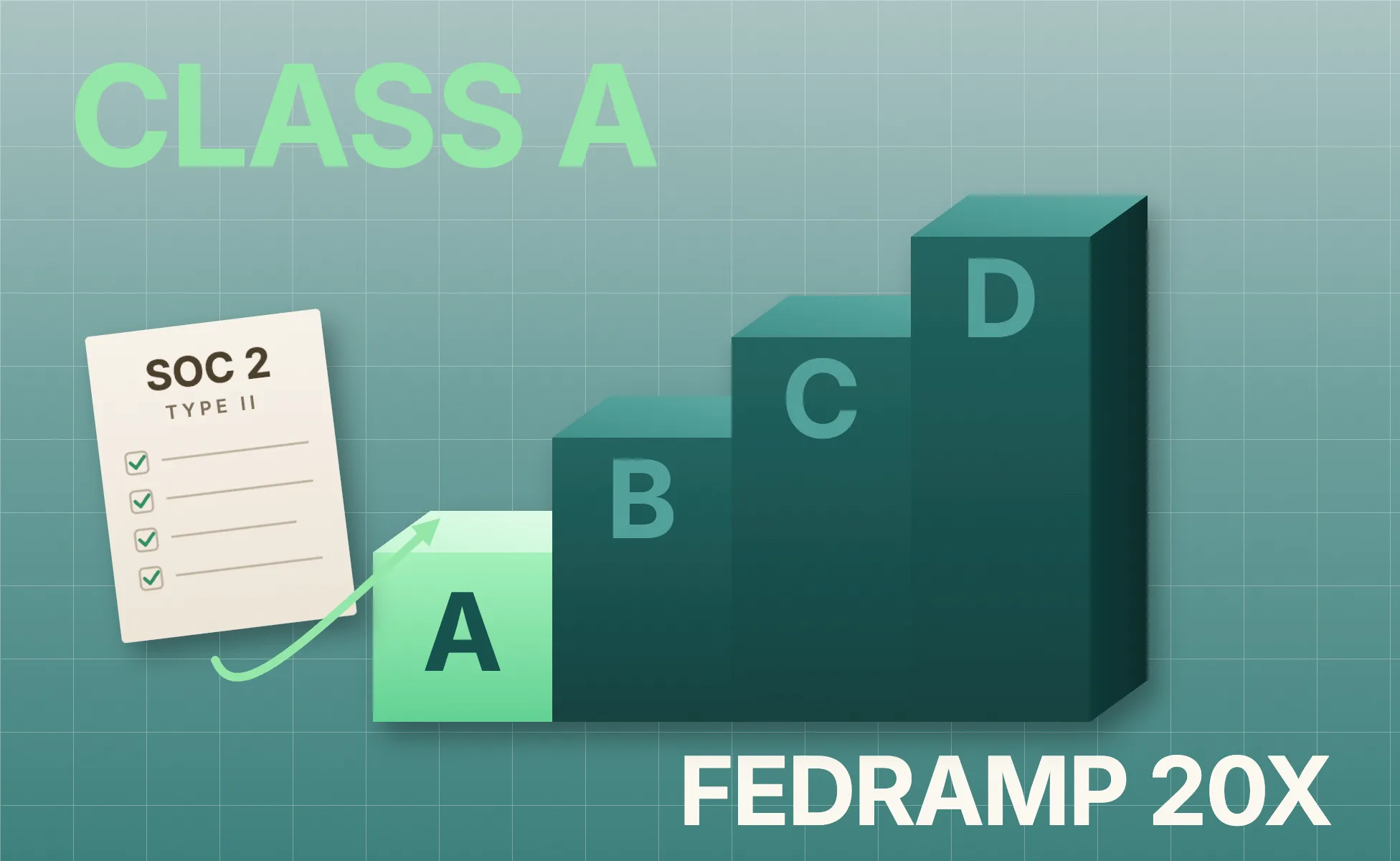
- FedRAMP 20x Class A is the entry tier of the four Certification Classes (A through D) introduced in the Consolidated Rules for 2026 (CR26). It builds on an assessment you already have, most often a SOC 2 Type II, and it doesn't require an agency sponsor.
- Class A requires you to address 24 additional FedRAMP rules, including seven Key Security Indicators (KSIs). Your existing controls may already support some of them.
- Class A is a starting point, not a finish line. Within two years of your initial listing in the Initial Implementation Phase, you need a Class B, C, or D assessment scheduled, or FedRAMP pulls the listing.
You have a SOC 2 Type II report and a federal deal waiting on security review. Sales needs to know whether FedRAMP 20x Class A will satisfy the buyer. Engineering needs to know what work remains.
Class A lets eligible SaaS providers build on an existing assessment without an agency sponsor. The first decision is whether it fits this deal: what will the agency use your service for, and what evidence does it need before use?
This guide explains eligibility, the additional requirements, and the work you need to plan after Class A.
Before you start, confirm that Class A fits the agency's intended use. Class A doesn't let you skip the harder work of a fuller assessment. It gets you in front of agencies sooner while you prepare for one.
What is FedRAMP 20x Class A?
An Initial Implementation Phase listing on the FedRAMP Marketplace shows that you are working toward certification. It does not mean you hold FedRAMP 20x Class A. You obtain the listing first, then apply to FedRAMP.
CR26 replaced FedRAMP's old certification labels (Low, Moderate, and High) with four classes. Classes B, C, and D line up roughly with the old Low, Moderate, and High baselines. Class A is new: it had no equivalent under the legacy Rev5 program. We cover how the classes relate to the underlying impact levels in our guide to the FedRAMP security controls baseline.
| Class | Roughly aligns with | How you get there |
|---|---|---|
| Class A | Nothing under Rev5 (new) | Approved alternative assessment (e.g. SOC 2 Type II) plus FedRAMP rules |
| Class B | Low | 20x Program Certification |
| Class C | Moderate | 20x Program Certification |
| Class D | High | Rev5 Agency Certification, which requires a sponsor. FedRAMP 20x Class D is not yet available; FedRAMP lists it as coming in 2027. |
Two things are worth keeping straight. First, Low, Moderate, and High didn't disappear. Agencies still use them under FIPS 199 to rate how sensitive their own data and systems are. They just aren't FedRAMP's certification labels anymore. Second, Class A doesn't promise any agency will accept you for any particular use. Agencies decide that for themselves. Class A suits low-risk pilots and non-sensitive workloads, and some agencies will want more before they buy.
When Class A makes sense (and when it doesn't)
Class A is a good first move if:
- You have a current SOC 2 Type II and an active federal opportunity, or a prime contractor asking about FedRAMP
- You want to be visible on the Marketplace while you build toward Class B or C
- The agency you're working with is open to a pilot or a low-risk use case
Go straight for Class B, C, or D if:
- The contract you're chasing already requires a higher class
- The agency's review finds that Class A does not provide enough assurance for the intended use
- You don't have any of the accepted alternative assessments
Either way, the work overlaps. The KSIs, the incident reporting, the certification package, and the trust center are all part of the higher classes too.
What your sales and engineering teams should agree on first
Sales should confirm the agency's intended use, required class, and procurement milestones. Engineering should confirm the service scope, evidence gaps, and ongoing workload. Together, decide whether Class A supports this opportunity before committing to a preparation plan.
Who qualifies for Class A?
The eligibility rule (FRC-CLA-ASF) requires that, in the past 12 months, you've completed one of these certification or equivalent processes, including an independent assessment where applicable:
- A SOC 2 Type II
- A GovRAMP assessment, at any impact level
- A FedRAMP Rev5 assessment, including FedRAMP Ready, at any historical impact level
That's the full list today. ISO 27001, HITRUST, and CMMC Level 2 came up during the RFC process but aren't accepted for Class A. ISO 27001 alone does not qualify. You would need to complete one of the accepted alternatives before applying. (Our comparison of ISO 27001 vs. SOC 2 covers how much of that work overlaps.)
A few more conditions apply:
- Your service has to be in scope for FedRAMP. Under the Marketplace rules, your offering needs a real federal use case: either agencies use it directly in a federal system, or it's a third-party resource inside something agencies use. A product sold only to help defense contractors meet CMMC, for example, doesn't qualify on that basis alone.
- You pick one program. You must not seek Rev5 Program certification and 20x Program certification for the same offering. A Rev5 agency certification alongside 20x is allowed, though FedRAMP discourages it.
- The 12-month window is strict. The rule counts from when the assessment was completed. If your last SOC 2 Type II audit wrapped up more than a year ago, you'll want your next one done before you apply.
What your SOC 2 already covers
Class A doesn't ask you to throw out your SOC 2 work and start again. Your report is the foundation of the package. Under FRC-CLA-EAM, you share:
- The full SOC 2 Type II report
- A bridge or gap letter, if applicable
- Verified documentation of the audit engagement
- An estimated schedule for your next SOC 2 report
- Any supplemental evidence, if applicable
Your existing policies may provide a starting point. Compare their scope, implementation, and evidence with the applicable FedRAMP requirements before deciding what needs to change.
What FedRAMP 20x Class A adds to your SOC 2 evidence
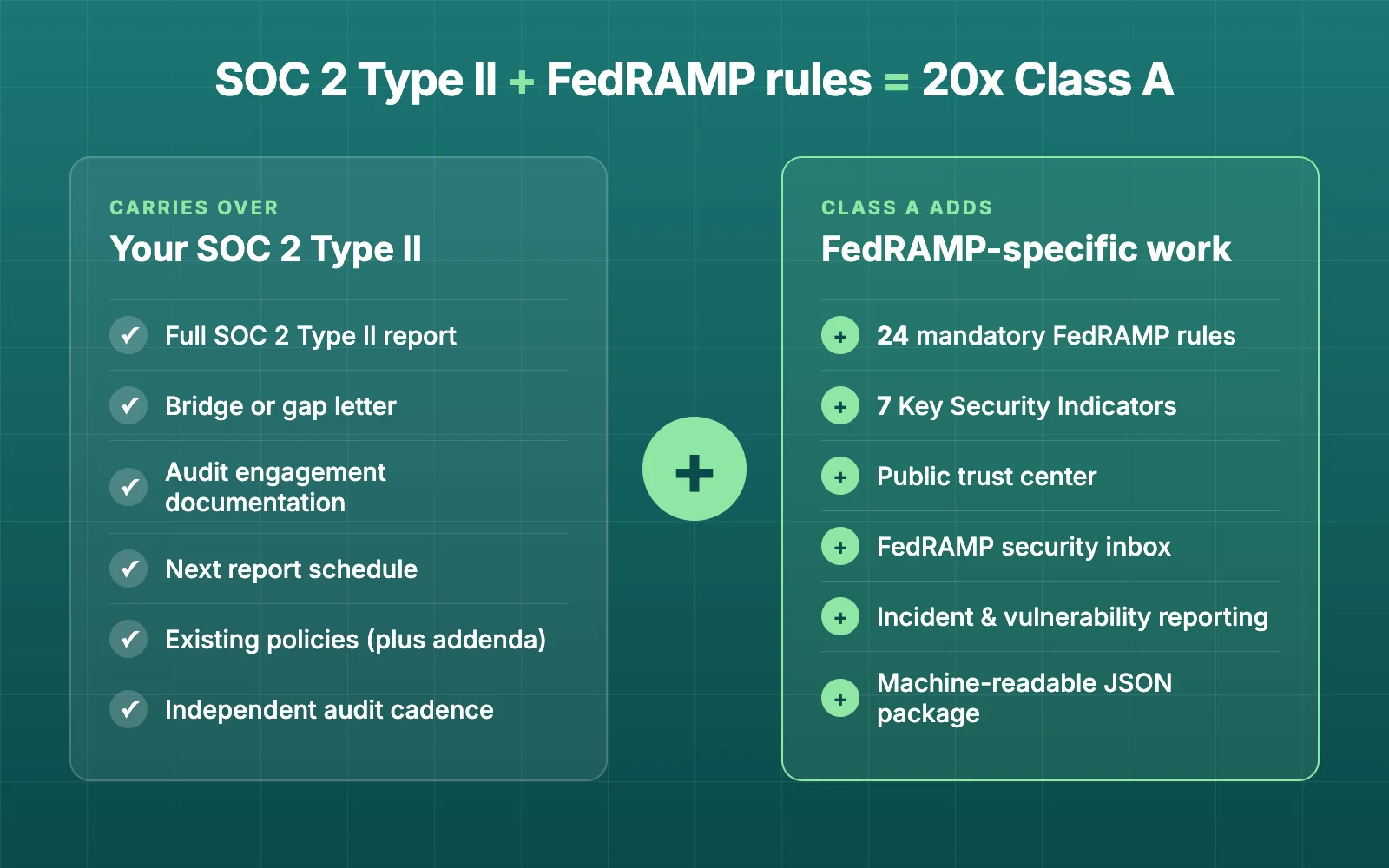
On top of the Class A rules themselves, FRC-CLA-MFR lists 24 mandatory rules. The 24 aren't the whole workload: the Class A rules, the application requirements, and the obligations those rules point to also apply. Grouped by theme, the 24 look like this. The owner column is a suggested planning aid, not a FedRAMP requirement.
| Area | What FedRAMP expects | Example rules | Suggested owner |
|---|---|---|---|
| Assessment scope | Identify resources that handle federal customer data or could affect its confidentiality, integrity, or availability | MAS-CSO-IIR | Engineering/security |
| Certification package | A complete package, with schema-valid JSON wherever the applicable rule requires it | FRC-CSO-PKG, FRC-CSO-JSN | Compliance lead |
| Public information and trust center | Public details about your service, shared through a trust center, with agency access controlled. Notify FedRAMP within five business days if you deny an agency access to certification data. | CDS-CSO-PUB, CDS-CSO-UTC, CDS-UTC-AAD | Compliance lead |
| FedRAMP communications | A dedicated FedRAMP security inbox that can receive email, and timely responses to required FedRAMP actions | AFC-CSO-INB, AFC-CSO-CRA | Compliance lead |
| Incident reporting | Deciding whether an incident is FedRAMP-reportable and issuing a final incident report | IEC-CSO-EFR, IEC-CSO-FIR | Engineering/security |
| Vulnerabilities | Detecting vulnerabilities in your service | VDR-CSO-DET | Engineering/security |
| Ongoing reporting | Supply an Ongoing Certification Report every three months and publish the next report date | CCM-OCR-AVL, CCM-OCR-NRD | Compliance lead |
| Independent assessment | Keeping up the independent assessment your underlying framework requires (e.g. your annual SOC 2 audit) | IVV-CSX-AIA | Compliance lead |
| Key Security Indicators | Seven KSIs, plus documentation of how you address them | SDR-CSX-KSI and the KSIs below | Engineering/security |
The seven KSIs describe security outcomes you must address and document. Several call for persistent review, which FedRAMP distinguishes from uninterrupted monitoring.
- KSI-CMT-LMC: record and monitor changes to the service
- KSI-CNA-RNT: persistently review configurations that restrict incoming and outgoing network traffic
- KSI-CED-RAT: persistently review the effectiveness of general, role-specific, engineering, incident-response, and recovery training
- KSI-IAM-AAM: automate lifecycle and privilege management for accounts, roles, and groups
- KSI-IAM-APM: use passwordless methods where you can, and strong passwords with phishing-resistant MFA where you can't
- KSI-INR-RIR: persistently review whether documented incident-response procedures are effective
- KSI-SVC-SIN: encrypt information or otherwise protect it against unwanted access or changes
Beyond the mandatory list, FedRAMP lists 10 recommended rules (things like ongoing incident reports, drift detection, and fast vulnerability evaluation) and 9 optional ones (like using validated cryptographic modules or quarterly review meetings). Recommended rules require a documented decision about how you address them, including reasons for departing from the recommendation. Optional rules are discretionary. Check your target class before deciding which additional work to do now.
Comparing ways to manage this work? Our FedRAMP readiness tool guide covers control mapping, evidence collection, and ongoing upkeep.
Where Mycroft fits
Mycroft maps the controls you already have to the Class A rules, collects evidence for the KSIs, and helps you prepare the FedRAMP documentation. Your team gets a clear view of the work it owns and what Mycroft handles.
We've been through this ourselves: Mycroft GRC Platform is listed on the FedRAMP Marketplace under FedRAMP 20x Class A. View the official Marketplace listing.
Have a federal deal waiting? Book a demo to review your Class A gaps and the work needed for your buyer's requirements.
How to get FedRAMP 20x Class A, step by step
- Confirm you're eligible. Check that your SOC 2 Type II (or GovRAMP or Rev5 assessment) was completed in the last 12 months, and that your service has a real federal use case.
- Get listed on the Marketplace first. FedRAMP requires an Initial Implementation Phase listing before you can apply for certification. You request it through FedRAMP's Provider Listing Request Form (email applications aren't accepted). You'll need to publish public information about your service and show progress toward certification, updated at least quarterly, in a trust center or on your website. The two-year clock starts here.
- Close the gaps. Address the 24 mandatory rules, including the seven KSIs, and update any policies that don't meet the FedRAMP requirements.
- Assemble and check the package. Include the Certification Package Overview, Security Decision Record, a real or example Ongoing Certification Report, and your external assessment materials. Supply schema-valid JSON wherever the applicable rule requires it, plus required human-readable versions. You must verify and validate the package's current status within the seven days before submission. A separate review by a FedRAMP Recognized assessor is optional for Class A.
- Apply through Program Certification. Complete the FedRAMP Certification Application Form yourself. A third party can help you prepare, but it can't submit on your behalf.
Once you're in, the work keeps going. You'll owe an Ongoing Certification Report every three months, the independent assessment your underlying framework requires, and a working FedRAMP security inbox for as long as you're listed.
The two-year clock
Class A is an on-ramp. Under MKT-IIP-DLA, you have two years from your initial listing in the Initial Implementation Phase to show that a Class B, C, or D assessment has been scheduled. Miss that, and FedRAMP removes your listing until you can show one is.
There's a shorter clock on the buyer side, too. AGU-USE-CLA recommends that agencies limit approval of a Class A service to 12 months unless the provider is actively pursuing Class B, C, or D. This is separate from the Marketplace assessment-scheduling deadline. So if you want agencies to keep using you, they'll want to see real progress toward the next class.
That's why it's worth treating Class A as the first phase of a plan, not a project of its own. Every KSI you automate and every recommended rule you address now is work you won't have to do under deadline later.
Key dates
| Date | What happens |
|---|---|
| July 4, 2026 | CR26 takes effect. New FedRAMP 20x applications must follow it. |
| January 1, 2027 | CR26 becomes mandatory for new Rev5 applications and for active 20x certifications. |
| June 11, 2027 | FedRAMP stops accepting new Rev5 certification applications. |
| February 1, 2028 | Grace periods end. Offerings not following CR26 lose their FedRAMP certification. |
Source: FedRAMP deadlines. Rules checked November 16, 2026. These are overall milestones; individual rules can have earlier deadlines.
Why FedRAMP built a SOC 2 on-ramp
FedRAMP 20x started from the direction set in OMB memo M-24-15, which pushed FedRAMP toward automation and toward reusing existing security work. FedRAMP floated accepting outside commercial frameworks in RFC-0022. In NTC-0007, FedRAMP said SOC 2 Type II was the external framework agencies most frequently used for pilot approvals. That made it the initial test case for reusing commercial assessments. The final CR26 rules kept SOC 2 and added GovRAMP and prior FedRAMP assessments.
Start with the SOC 2 you already have
Class A shortens the path for companies that already have a current SOC 2 Type II. The gap to FedRAMP 20x Class A is real but bounded: 24 additional rules, seven KSIs, a trust center, and a certification package, plus the ongoing reporting that keeps you listed.
Have SOC 2 and a federal deal in progress? Book a demo to review your Class A gaps, your team's workload, and how Mycroft supports the ongoing requirements.