IT vendor risk management: A practical guide for lean security teams

TLDR:
- IT vendor risk management assesses and monitors the risks vendors introduce to your systems and data
- Data breaches and operational disruption are the two most common forms of vendor risk
- You don't need more headcount to build a strong vendor risk management program
A prospect's security questionnaire lands in your inbox on a Tuesday afternoon. One question asks you to list every vendor with access to customer data, describe your vendor risk assessment process for each one, and attach your most recent review. You have forty-three SaaS subscriptions, and you're also the person who approved most of them, the person who will answer this questionnaire, and the person who will be doing the actual security work tomorrow morning.
This is the reality for most founding CTOs and early security hires: Enterprise deals now require you to answer for every vendor relationship in your stack, whether or not you have anyone dedicated to managing it. And the numbers back up what that Tuesday afternoon feels like. In 2026, organizations use an average of 118 SaaS applications, an 11% increase from last year, according to BetterCloud's State of SaaS report. Meanwhile, 63% of U.S. organizations say they lack 24x7 security coverage, 16 points above the global average, according to Bitdefender's 2026 Cybersecurity Assessment. Put those two numbers next to each other, and you get more tools touching customer data than ever, and not enough security coverage to watch them.
That gap matters because vendors are now a primary route into a breach. Verizon's 2026 Data Breach Investigations Report found that breaches involving a third party jumped 60% year over year, now accounting for 48% of all breaches in its dataset. That statistic alone is an argument for a better system, not simply more headcount.
This article covers five habits of a strong IT vendor risk management program, how to tier your stack so effort matches exposure, and what this costs to run.
What is IT vendor risk management?
That is a narrower problem than vendor risk management (VRM) in general, which also covers your office supplier, your law firm, and the contractor who redesigned your lobby. The distinction matters because an IT vendor sits inside your environment or touches your data directly, which means its failures become your failures in a way a general vendor's never will.
Third-party risk management, or TPRM, is the umbrella term that includes both. If your organization only has one risk management program, it is worth deciding early whether it is scoped to IT vendors specifically or to third-party vendors more broadly. The due diligence, vendor contracts, and ongoing monitoring look different for a payroll platform than they do for an office cleaning service.
Why vendor risk doesn't wait for you to have a security team
A vendor relationship expands your attack surface and your compliance requirements the moment you sign up, regardless of whether you or anyone on your team is watching it. Your security posture is only as strong as your weakest vendor, and cybersecurity risks from a single unreviewed tool can undo everything else you've done right. You rarely find out which vendor that is until something breaks.
Verizon's 2026 report groups third-party risks into three overlapping categories:
- A vendor in your software supply chain, whose code or infrastructure has a flaw that becomes a breach entry point into your system.
- A vendor hosting your data directly, meaning the vendor's own systems are breached, or your account with that vendor is compromised and used to access the data it holds on your behalf.
- A vendor with a live connection into your environment, where attackers use said connection (e.g., via credentials the vendor holds) to move laterally into your systems.
The above breakdown explains why a single vendor breach can look so different depending on which category it falls into. A compromised open-source library in your supply chain is a different kind of bad day than a compromised login to a vendor holding your customer records, even though both get filed under vendor risk.
The 2 riskiest areas of vendor relationships: Data breaches and operational disruption
It helps to sort IT vendor risks into what threatens your data and what threatens your ability to operate. Here's a breakdown of each bucket:
Risks to your data
- Security risk, meaning data breaches and credential leaks that expose customer or company sensitive data
- Regulatory compliance risk, meaning shared liability under frameworks like SOC 2, ISO 27001, GDPR, or HIPAA when a vendor mishandles data you are accountable for
- Reputational risk, meaning the customer-facing fallout when a vendor incident becomes your incident in the eyes of the people who trusted you with their data
Supply chains are part of this picture too. Bitdefender's 2026 research found that 23% of global respondents rank supply chain abuse (i.e., compromised vendors and open-source libraries) among their top three attack concerns.
Risks to your operations
- Financial risk, meaning vendor instability, hidden costs, or outright financial instability on the vendor's own side
- Integration risk, meaning API failures or broken authentication when a vendor pushes an update you did not test for
- Performance risk, meaning missed service level agreements and latency that cascades into your own product
- Resilience risk, meaning a vendor with no tested disaster recovery plan or business continuity plans, and no backup if their infrastructure goes down
The CrowdStrike outage is the cleanest example of the second bucket. Nothing was breached. A routine update from a trusted vendor still knocked systems offline worldwide, which is a useful reminder that your own business continuity plans have to account for vendors behaving badly by accident, not just vendors getting hacked.
The 5 building blocks of a vendor risk management program
To start managing vendor risk properly, start with these five habits, applied consistently across the entire vendor lifecycle, not just at the moment of signing.
1. Due diligence as a prerequisite before signing anything
Minimum viable due diligence, done before a contract is signed, means asking for a SOC 2 report or equivalent certification, running through a short security questionnaire, and confirming the vendor has a named point of contact for security incidents. By doing this check once, before signing, you help reduce your chances of a high-risk vendor getting onboarded at all.
2. Vendor risk assessments that don't take a week per vendor
A full enterprise-grade risk assessment, like the Cloud Security Alliance's Consensus Assessments Initiative Questionnaire (CAIQ) v4.1, includes 283 questions. Copying that template for a 15-person company evaluating a project management tool is how vendor risk assessments become a thing everyone agrees matters, but nobody wants to do.
Instead, right-size the assessment to what the vendor can actually access and how vendor performance affects your own operations: A tool that touches sensitive data gets a real assessment, while one that only handles internal meeting scheduling gets a lighter one. Your organization's risk appetite should scale the effort, not the other way around, and your risk tolerance for a critical vendor should look nothing like it does for a low-stakes one.
3. Vendor contracts as your first line of vendor risk oversight
Breach notification timelines, audit rights, and explicit data handling terms are the clauses that do the enforcement work, so you are not relying on manual follow-up. They should also cover data residency and jurisdiction. Bitdefender's 2026 research found that 87% of U.S. respondents would switch vendors over data sovereignty concerns, the highest of any country surveyed. For IT teams, that means data residency has stopped being a niche legal detail and become table stakes vendors are expected to answer upfront, not negotiate later.
Start by auditing your existing vendor contracts for data residency, jurisdiction, and sub-processor clauses. If a vendor cannot answer those questions clearly, that is itself useful information about their security posture.
4. Continuous monitoring instead of annual reviews
An annual review tells you what a vendor's security posture looked like on the day you checked. It says nothing about the other 364 days. This is exactly what ongoing monitoring is built to confirm.
There are a lot of tools that tell you what's wrong, but not that many that tell you what you should do about it—and it applies just as much to vendor monitoring as it does to internal security tooling. A dashboard that flags a vendor's expired certificate is useful. A dashboard that flags it and tells you whether that expiration is actually a risk to you, given what that vendor can access, is the thing that saves you time instead of adding to your queue.
5. Governing the AI tools no one approved, and the data security gap they leave behind
From Claude to ChatGPT, employees are often using free-tiered, never-reviewed AI-powered SaaS tools that touch sensitive company or customer data—without ever entering your vendor risk process. Verizon's 2026 report confirmed this use of shadow AI: 67% of users are accessing AI services through non-corporate accounts on their corporate devices, and that frequent AI usage among employees, authorized or not, tripled from 15% to 45% in a single year. Shadow AI is now the third most common non-malicious insider action showing up in data loss prevention datasets, a fourfold increase from the previous year.
Bitdefender's research adds a second layer to this: Only 51.8% of organizations globally in 2026 claim full visibility into which AI tools their employees are using, and even the U.S., which leads at 63% visibility, still has more than a third of organizations unable to see all the AI tools touching their environment.
| Sanctioned vendor path | Shadow AI path |
|---|---|
| Employee requests tool | Employee signs up directly with personal credentials |
| Due diligence and contract review | No company or contract review |
| Tiered and monitored | — |
| Data flows through a reviewed and approved vendor | Company or customer data enters an unvetted tool |
Tiering your SaaS stack before it outgrows you
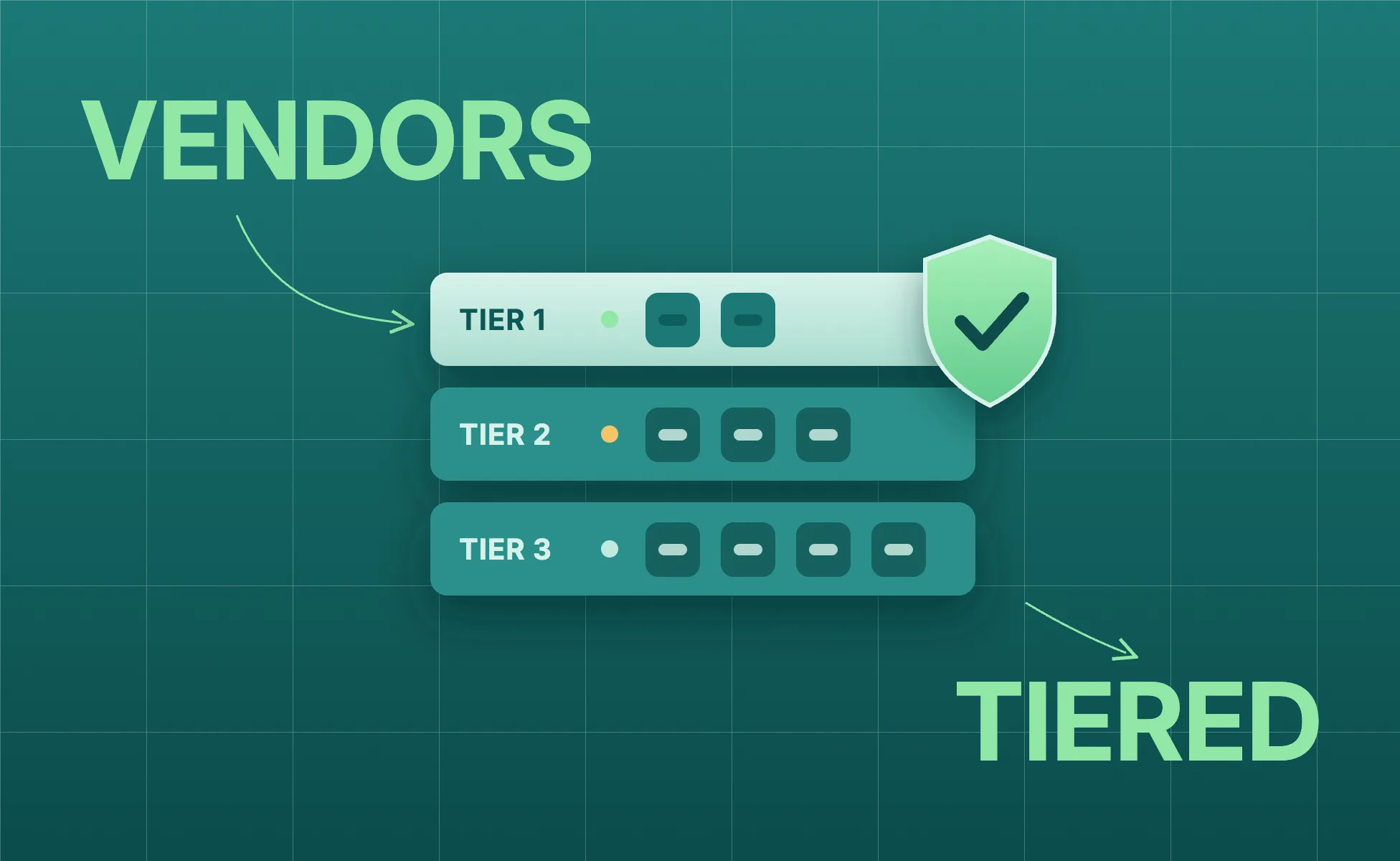
Not every vendor deserves the same level of scrutiny. Critical vendors need continuous attention, while low-risk ones don't. Figuring out which is which is a matter of matching effort to actual exposure. A practical signal that you have outgrown the spreadsheet method is that your vendor count has crossed some threshold you can no longer hold in your head, the number of vendors touching sensitive data keeps climbing, or your review cadence has quietly slipped from quarterly to whenever someone remembers.
Here's a breakdown of how to tier different levels of vendors:
| Risk tier | Data sensitivity | Review cadence | Example |
|---|---|---|---|
| Tier 1 | Extreme: Development or infrastructure tool with production access to internal systems | Continuous monitoring | Cloud hosting provider |
| Tier 2 | High: Touches sensitive financial and personal data for every employee | Quarterly | Payroll platform |
| Tier 3 | Low: Limited or no access to sensitive data with minimal operational dependency | Annually | Marketing SaaS tool |
Once you have a tiering system in place, the next natural question is what to actually look for in software built to manage it, which is exactly what our guide to evaluating vendor risk management software walks through.
What running an IT vendor risk management program costs (and what it returns)
Having a dashboard is not the same as having someone run the program for you. Bitdefender's 2026 research found that 60.2% of U.S. IT and security professionals say they lack the time or expertise to fully utilize their current security tools, the highest of any country in the survey. A tool that surfaces a hundred vendor risk findings a month is only useful if someone has the bandwidth to triage them, chase down the ones that matter, and close the loop. Otherwise, you have traded a spreadsheet you ignored for a dashboard you ignore with better design.
Where reframed as an economic model, there are three options to consider:
- Staff internally, which costs analyst hours most lean teams do not have
- Stitch together point solutions, which costs integration overhead plus the same triage problem from a different angle
- Consolidate to a managed approach that trades both of the above options for a predictable cost, since the operational work of running the program, not just the software that logs it, is built in.
At Mycroft, this is the whole premise behind our approach to Third-Party Risk Management (TPRM): The platform handles monitoring and risk triage, and our team actually does the work, so you are not the one holding down the queue at midnight.
There is also a return here that has nothing to do with avoiding a breach or regulatory fines: The same oversight that prevents security incidents also shortens enterprise sales cycles, since a specific answer to how you manage vendor risk moves a deal forward instead of stalling it in legal review. Wisedocs, a Mycroft customer, moved from slow, manual security reviews to automated vendor risk management. This shows up directly as faster enterprise and government procurement cycles, with vendor questionnaires being the bottleneck.
5 common mistakes lean teams make in IT vendor risk management
Even teams that mean to do this well tend to fall into the same handful of traps. Here's where programs most often break down:
- Treating vendor risk management as a one-time task instead of an ongoing process that needs revisiting as vendor systems and their access change
- Skipping tiering entirely, which means high-risk vendors and low-risk ones get the exact same five minutes of attention and the same weak risk mitigation as a result
- Relying on annual reviews with no ongoing monitoring in between, which leaves eleven months of blind spots and mounting risk exposure
- Signing vendor contracts with weak or missing breach notification and audit clauses, which removes your main lever if something goes wrong
- Flagging a potential risk and never assigning anyone to actually mitigate it, which is the quiet failure mode behind most compliance failures and "we knew about that" postmortems
If any of these look uncomfortably familiar, our complete guide to third-party vendor risk management goes deeper into why so many programs stall out here, and what fixing it actually looks like.
IT vendor risk oversight needs a better system, not a bigger team
Unless you work at an organization with a massive headcount budget—unlikely anywhere these days—you cannot hire your way out of this problem, and trying to is how security budgets balloon without the underlying risk actually going down. The goal was never a bigger team. It's a system that scales oversight without scaling headcount, so the fiftieth SaaS subscription gets the same scrutiny as the first one did, whether or not anyone remembers signing up for it.
If you are ready to see what that looks like for your entire vendor ecosystem, book a demo or take a closer look at our third-party risk management platform.